Over 40 fish farms ‘unsatisfactory’, says government watchdog https://t.co/o1vluv6wwt via @ferretscot @ScottishEPA @SSPOsays @scotseafarms @MowiScotlandLtd @scottish_salmon
— Don Staniford (@TheGAAIA) October 19, 2021
The Ferret reported (19 October 2021):
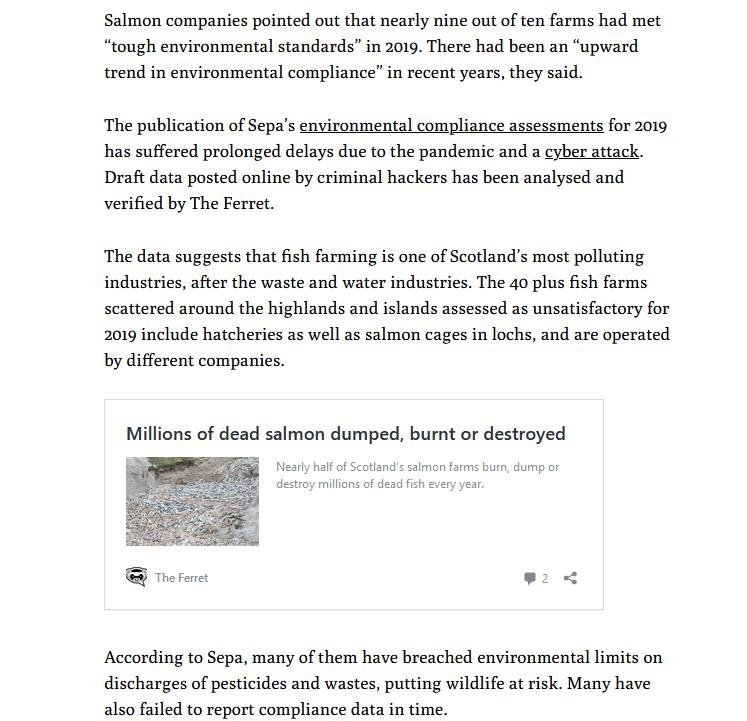
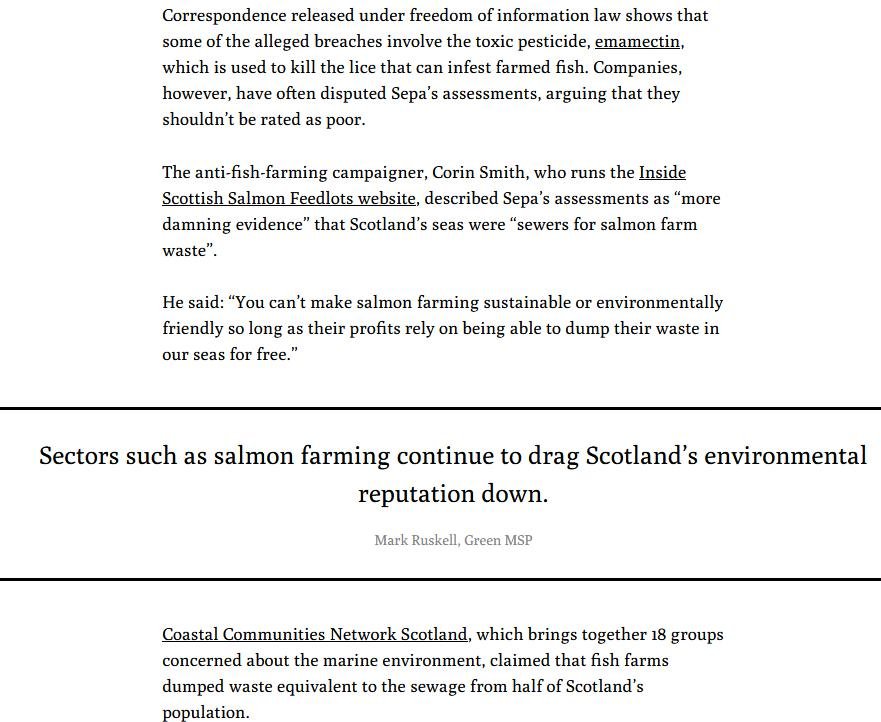
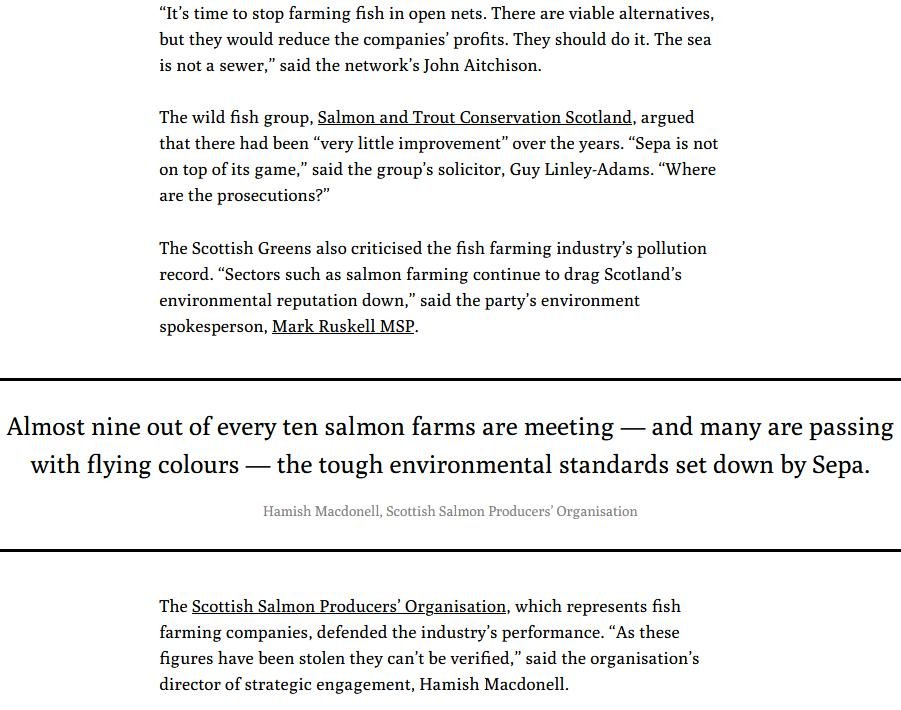
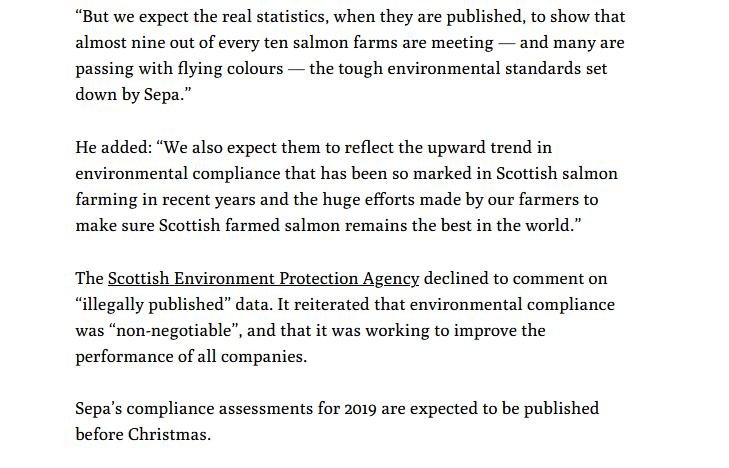
Which 40+ fish farms broke environmental rules? Is there a list anywhere other than on the Dark Web? @SSPOsays @MowiScotlandLtd @scotseafarms @salmon_scottish @tavishscott @HamishMacdonell
— Don Staniford (@TheGAAIA) October 19, 2021
Which salmon farms are currently failing SEPA's compliance assessment? Here's data naming & shaming failing fish farms in 2016 & earlier https://t.co/5GE4Q8xGWk Are less salmon farms failing or more? @SSPOsays @tavishscott @TerryAHearn @MowiScotlandLtd @robedwards53 @FerretScot pic.twitter.com/abAndTCzAh
— Don Staniford (@TheGAAIA) October 19, 2021
The Herald reported (19 October 2021):
Leaked data reveals over 40 fish firms 'unsatisfactory' over environmental breaches @heraldscotland @SalmonTroutCons @JohnAitchison1 @HamishMacdonell @GuyLinleyAdams @tavishscott @MairiGougeon @markruskell https://t.co/Bl9CQjxxdf
— Don Staniford (@TheGAAIA) October 19, 2021
Tuesday's Herald.
Day 1 of our investigation series "How green is Scotland?"More than 400 industrial sites have been damned as “unsatisfactory” on pollution, according to data from Scotland’s environmental watchdog.#TomorrowsPapersToday
Subscribe: https://t.co/Ms01UHkxsw pic.twitter.com/oo8mBLTL3q— The Herald (@heraldscotland) October 19, 2021
Front page in today's @heraldscotland – how green is Scotland? pic.twitter.com/2QGgYZ1BIU
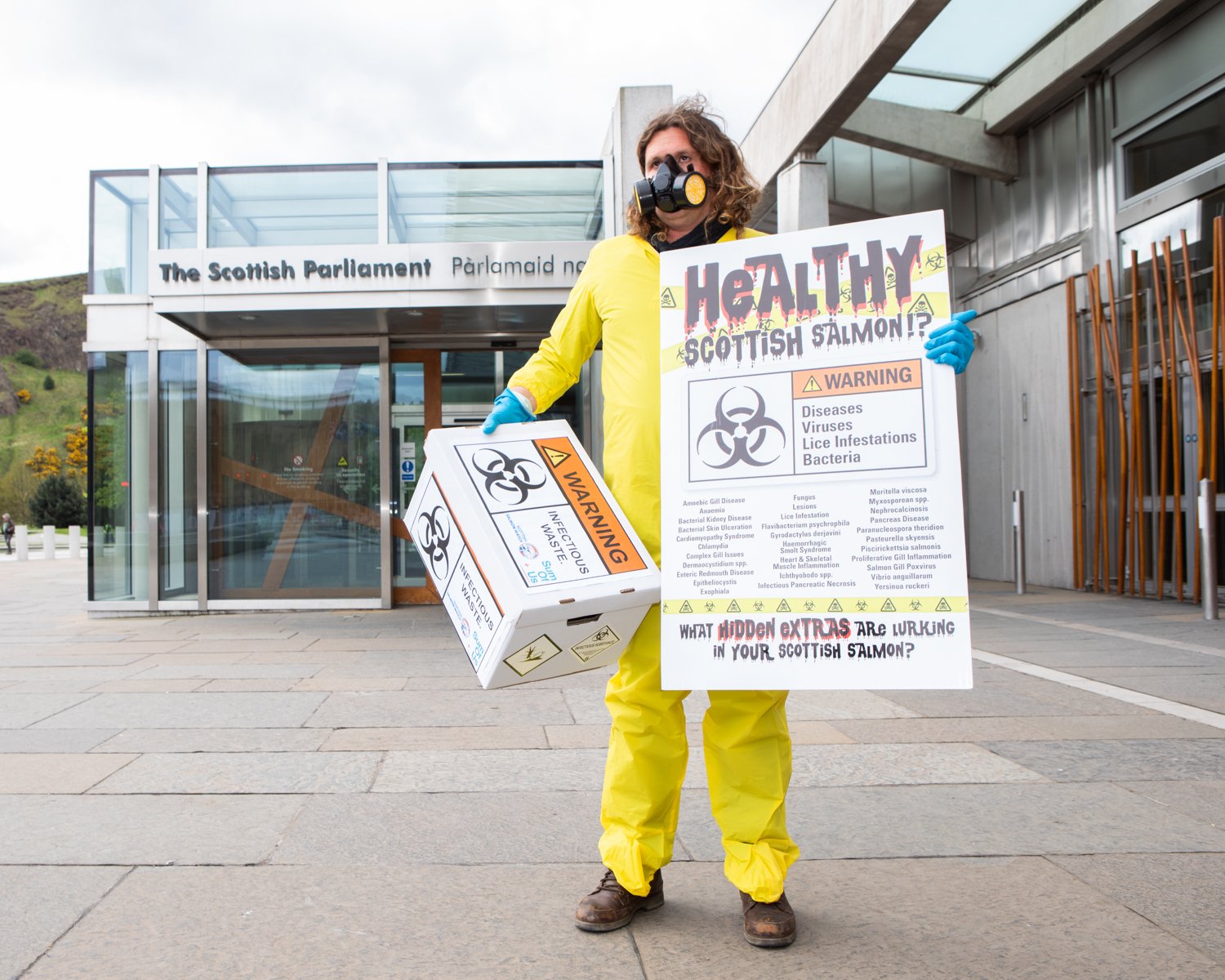
How green is 'Scottish' salmon farming? @SSPOsays @ScottishEPA @TerryAHearn @nature_scot @MairiGougeon @HamishMacdonell @robedwards53
Which 40 fish farms are breaching environmental rules? pic.twitter.com/njoDSroO69— Don Staniford (@TheGAAIA) October 19, 2021
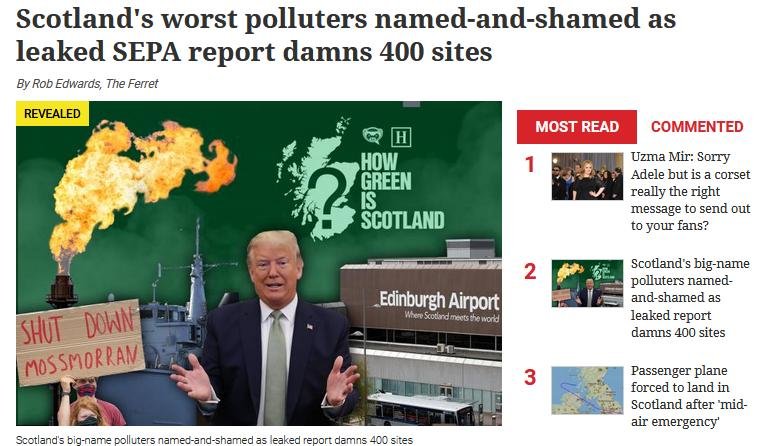
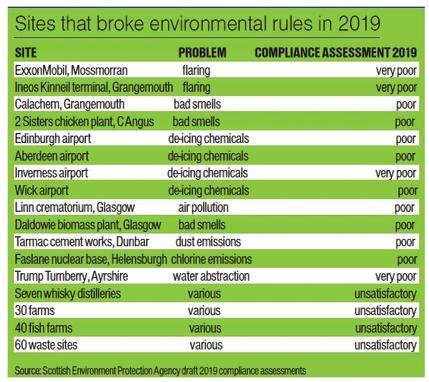
Misleading: "Scotland's worst polluters named-and-shamed" screams @heraldscotland https://t.co/ntqR3FEAYn
But why are 40+ fish farms not named & shamed? @ScottishEPA @robedwards53 @SSPOsays
Which companies are responsible? @salmon_scottish @CookeScotland @DFSeafoods pic.twitter.com/loCntnqxSw— Don Staniford (@TheGAAIA) October 19, 2021
The latest data available details the following fish farms which failed SEPA's compliance assessment in 2018 – including two salmon farms rated as 'Very Poor' and over 30 fish farms rated as 'Poor':
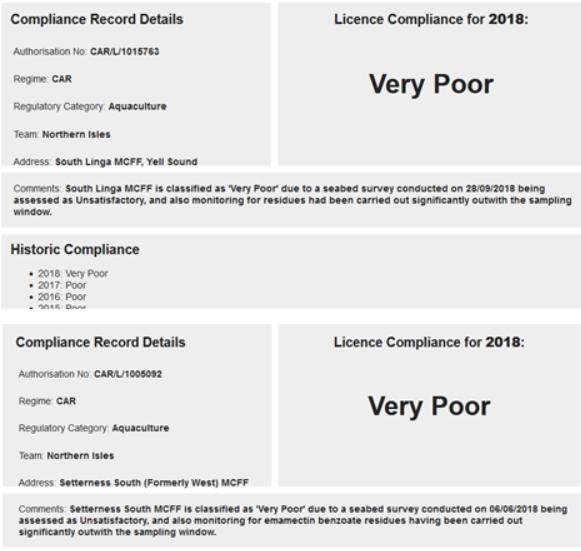
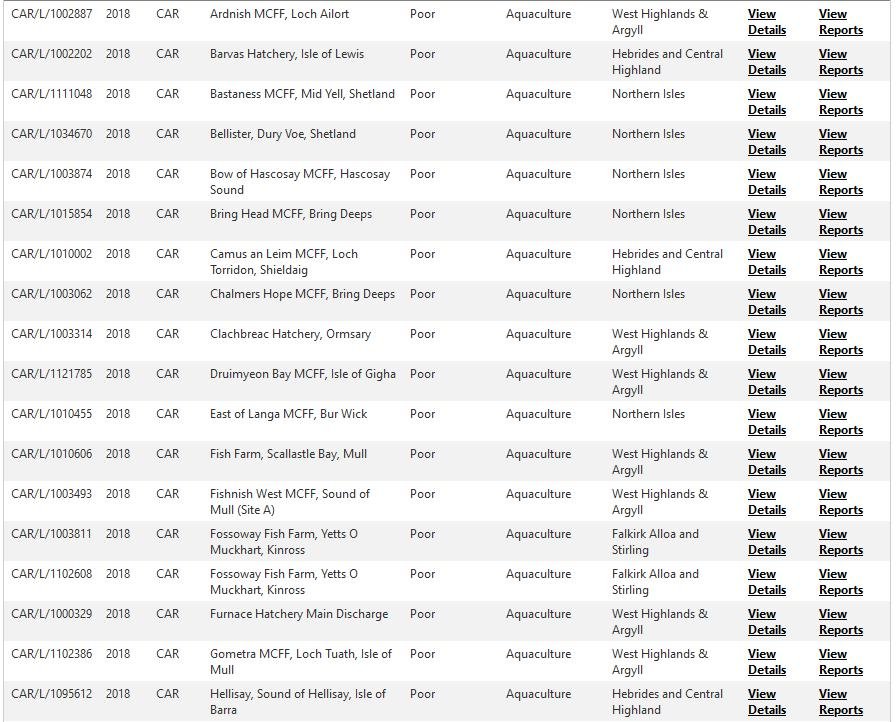
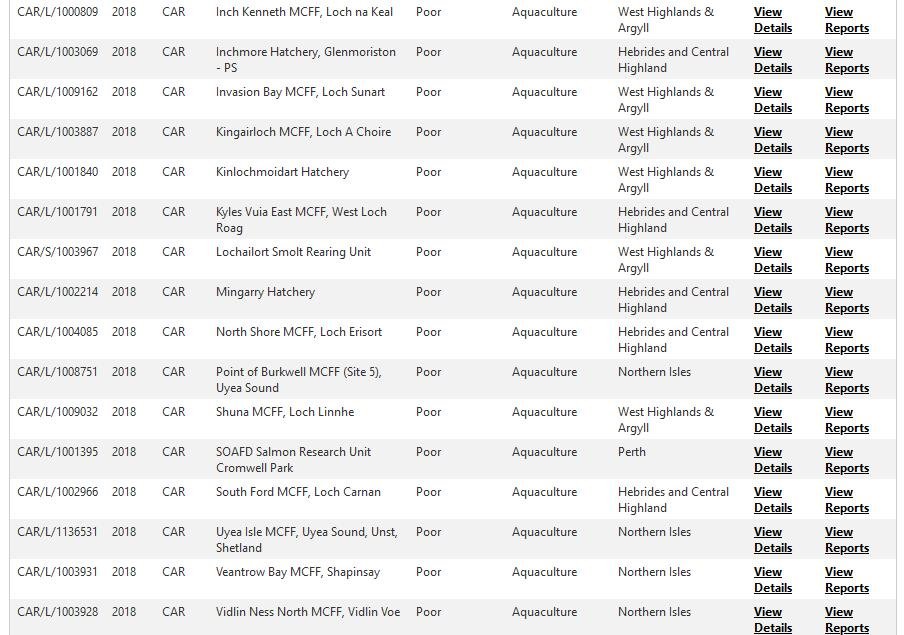
Here's the latest compliance data @ScottishEPA detailing failing fish farms @SSPOsays – including two "Very Poor" salmon farms @GriegShetland & 30+ "Poor" fish farms across Scotland @MowiScotlandLtd @scotseafarms @HGSalmonUK @CookeScotland
Why are the companies not named? pic.twitter.com/7OFSgQPYJE— Don Staniford (@TheGAAIA) October 19, 2021
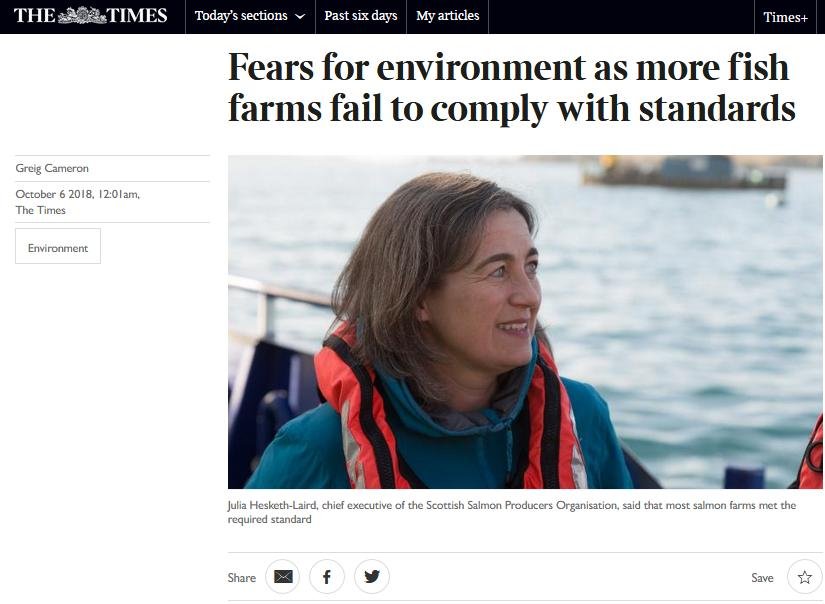
The Times reported in October 2018:
STV News reported (5 October 2018):
STV News on the "nightmares" for @sspo following a damning report by @ScottishEPA (with Scottish Salmon Watch saying the industry was "riding roughshod over regulations") https://t.co/20XkzD7tX8 (starts at 3 min 35 secs) @STVNews @SSPOsays @JulieHL @scotgp @ScotSalmonTank pic.twitter.com/zRGsQU6zrN
— Don Staniford (@TheGAAIA) October 5, 2018
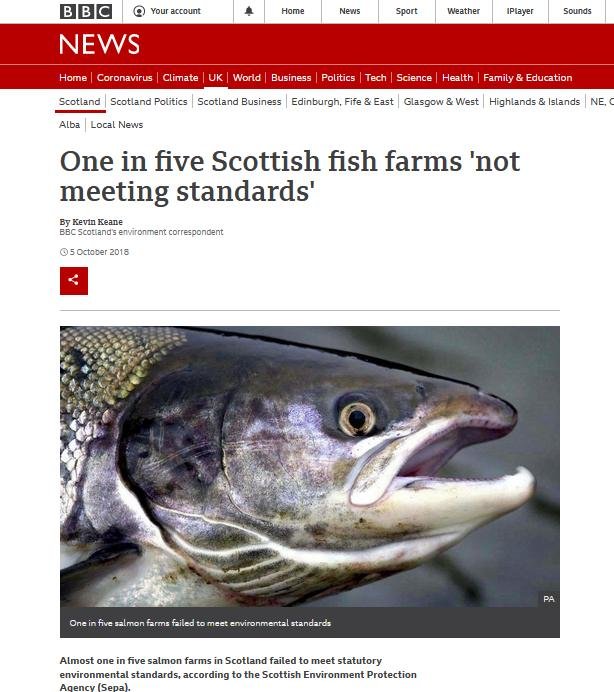
BBC News reported (5 October 2018):
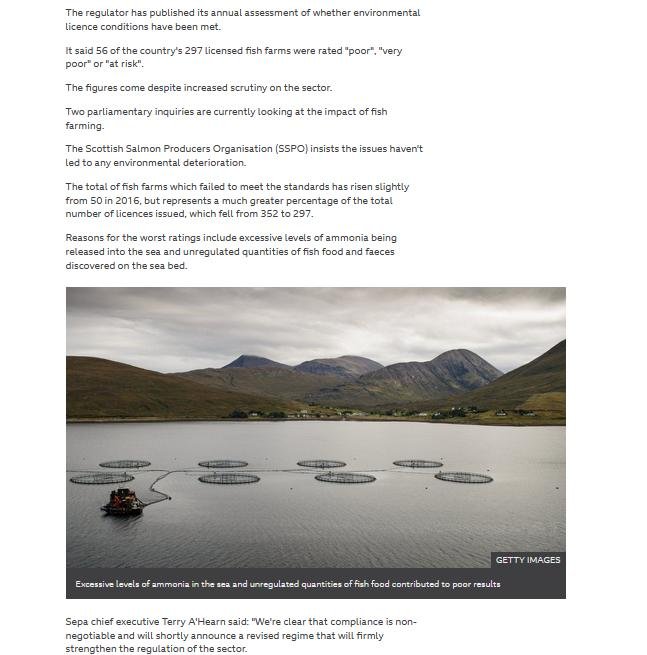
The Daily Mail reported in July 2018:
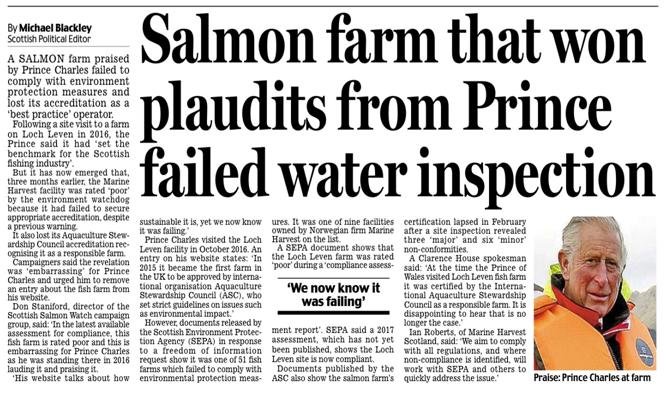
Scottish Salmon Watch reported in July 2018:
Failing Fish Farms: Scotland's Worst Salmon Farms Named & Shamed
– 51 sites including Marine Harvest's Loch Leven salmon farm promoted by Prince Charles & Scotland's first salmon farm to be certified by the ASC (now expired)
Documents disclosed by the Scottish Environment Protection Agency (SEPA) via Freedom of Information (FOI) expose the poor practices of Scotland's worst salmon farms. In February, BBC News revealed that 51 fish farms in Scotland were failing to comply with environmental protection measures yet SEPA failed to name the companies responsible. In July, SEPA finally disclosed documents naming and shaming the salmon farming companies guilty of non-compliance during 2016 [1].
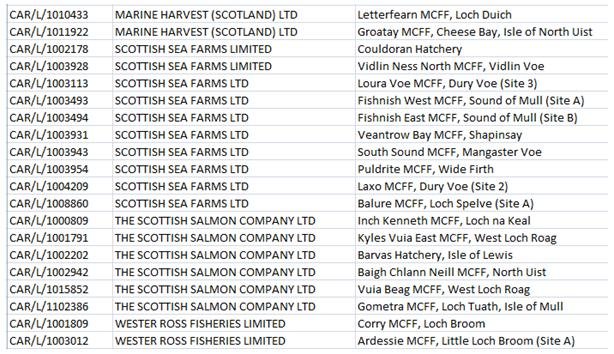
Scottish Salmon Watch can now reveal that Scottish salmon's worst operator is Norwegian-owned Scottish Sea Farms with 10 fish farms failing SEPA's compliance assessment in 2016 (with 9 farms assessed as "Poor" and one as "Very Poor"). Norwegian-owned Marine Harvest and Canadian-owned Cooke Aquaculture closely follow both with 9 failing fish farms and Jersey-registered and Swiss-owned the Scottish Salmon Company with 6 failing fish farms (all are members of the Scottish Salmon Producers Organisation).
One of Marine Harvest's 9 salmon farms rated as "Poor" was Loch Leven – the first salmon farm in Scotland to be certified by the Aquaculture Stewardship Council and one of only two ASC-certified farms in Scotland before its certification expired in February 2018. Marine Harvest's other ASC-certified site in Loch Linnhe has had its certification "cancelled" according to the ASC and expires in November – with another three salmon farms operated by Marine Harvest (Duich, Loch Alsh & Ardintoul) also having their ASC-certification "cancelled" [2]. Marine Harvest's farm in Loch Leven was visited by Prince Charles in 2016 who said it "has set the benchmark" and described the operations as "sustainable".
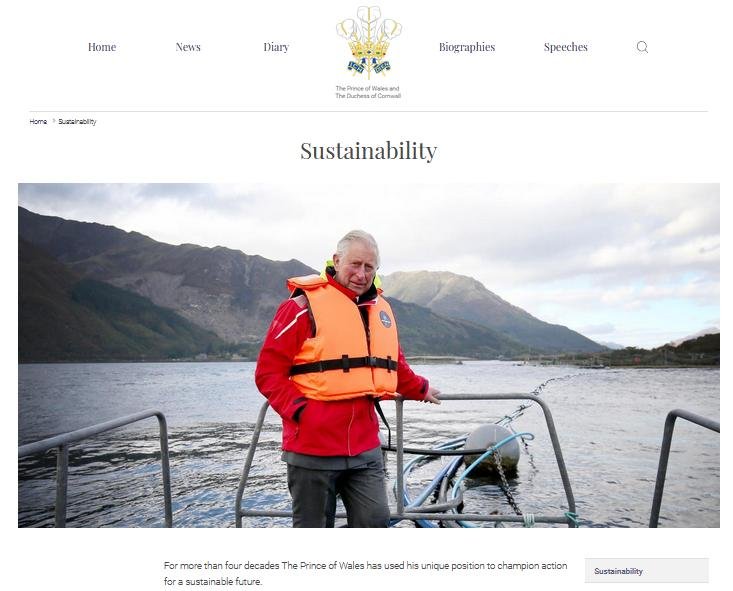
Photo: Prince Charles preaching about "sustainability" on his web-site using a photo of himself standing in front of Marine Harvest's of Loch Leven salmon farm (rated as "Poor" by SEPA)
Marine Harvest's salmon farm in Loch Duich – a Special Area of Conservation supposedly protected under EU Law – was ranked "Poor" by SEPA due to a significant failure for contamination of sediments with residues of the toxic chemical Emamectin benzoate.
Two of Scottish Sea Farms' 10 salmon farms rated as "Very Poor" or "Poor" were located at Fishnish in the Sound of Mull – the site of the killing a humpback whale in 2014 and exceedance of lice limits in January 2018. Fishnish A salmon farm "failed repeatedly" according to SEPA with "6 consecutive unsatisfactory surveys since 2006" and Fishnish B had "3 consecutive unsatisfactory surveys since 2010" leading to SEPA imposing a conditional reduction in biomass on both sites.
Another Scottish Sea Farm site in Loch Spelve at Balure on the Isle of Mull was rated "Very Poor" due to exceedance of the Environmental Quality Standard for residues of Emamectin benzoate (a toxic chemical known to kill lobsters) and evidence of drug over-dosing.
One of the Scottish Salmon Company's 6 salmon rated as "Poor" was Gometra salmon farm off the Isle of Mull – a site controversially approved back in 2012 despite a campaign calling it "dangerous" and a "blight on the horizon". Another "Poor" salmon farm operated by the Scottish Salmon Company is located at Inch Kenneth in Loch na Keal on the Isle of Mull – described by SEPA as failing all benthic surveys since 2002.
Cooke Aquaculture's hatchery in Furnace was rated "Poor" for effluent discharge failures into Loch Fyne whilst Wester Ross Fisheries – a company with a long history of pollution breaches – had two salmon farms assessed by SEPA as "Poor" due to 'unsatisfactory' benthic pollution in Little Loch Broom and Loch Broom.
Here's the list of 42 salmon farms rated as "Poor" or "Very Poor" in 2016 – download Excel spreadsheet obtained from SEPA via Operators List
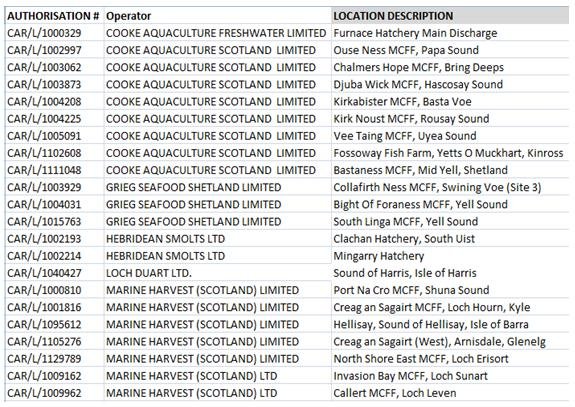
"Salmon farms across Scotland are riding roughshod over environmental regulations," said Don Staniford, Director of Scottish Salmon Watch. "Even the best salmon farm Scotland has to offer – Marine Harvest's Loch Leven farm championed by Prince Charles and certified by the Aquaculture Stewardship Council – has been officially ranked by SEPA as 'Poor'. How embarrassing – shame on Scottish salmon!"
HRH Prince Charles visits Scottish salmon farm #sustainability HRH Prince Charles and MH Steve Bracken. Marine Harvest Loch Leven Site. pic.twitter.com/ki2H5kTKnj
— william dowds (@fishfarmerwd) November 3, 2016
Download in full with Background and Notes to Editors via:
Press Release: "Failing Fish Farms: Scotland's Worst Salmon Farms Named & Shamed" (27 July 2018) (PDF)
The Global Alliance Against Industrial Aquaculture reported in February 2017:
Failing Fish Farms
– 18% rated "poor" by SEPA in 2015
Exclusive information obtained via FOI from the Scottish Environment Protection Agency (SEPA) lifts the lid on the "poor" performance of Scotland's marine salmon farms – with almost a fifth (18%) classified by SEPA as failing and responsible for "at least one significant breach". Norwegian-owned Marine Harvest, Scotland's largest salmon farming company, is the worst operator with 13 "failing" salmon farms in 2015 (that's 27% of the 49 marine salmon farms operated by Marine Harvest Scotland).
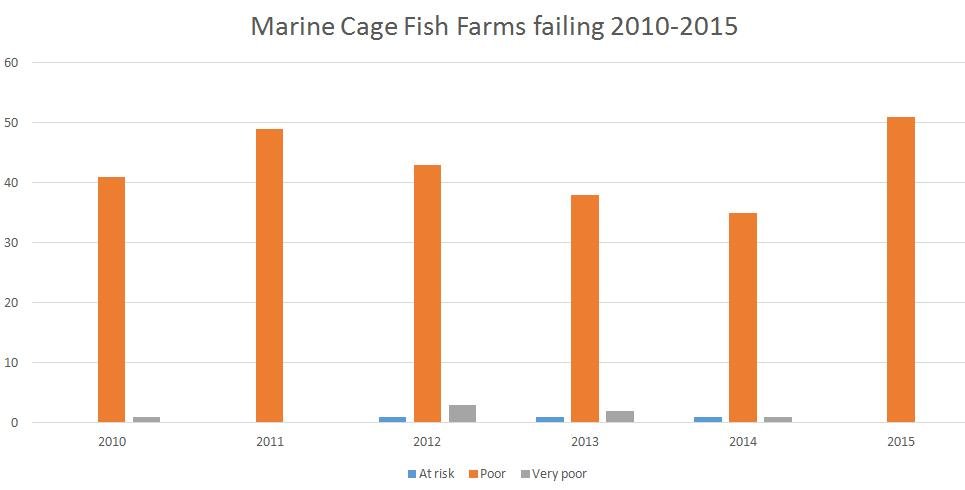
The number of marine salmon farms assessed by SEPA as "poor" rose from 37 in 2014 to 51 in 2015 (the worst year on record). Failures reported in 2015 included "biomass exceedance", "chemical residue exceedance", "insufficient monitoring", "chemical use exceedance" and "unsatisfactory seabed surveys".
In November 2016 SEPA published their 'Compliance Assessment' scheme which rated 58 fish farms as "poor" in 2015 (an increase from 2014 when there were 42 fish farms assessed as "poor"). Importantly, the data did not name the operators prompting a FOI request from GAAIA.
SEPA stated in a press release (10 November 2016): "Scotland’s fish-farming sector has seen a drop from 86% to 82% compliance over the past year, and SEPA is presently engaging with industry representatives to improve this."
However, compliance for freshwater cage fish farms, tanks and hatcheries was much higher with 98% of freshwater cage fish farms classified as being 'Excellent' or 'Good' in 2011 and 99% of tank farms and hatcheries classified as 'Excellent' or 'Good' in 2011 [1].
Based upon documents disclosed by SEPA in February 2017 (via F0187239 and F0187139), GAAIA can now reveal:
- 18% of marine cage fish farms were rated "poor" in 2015
- 2015 is the worst year with 51 rated as "poor" (up from 37 in 2014)
- Marine Harvest is the worst operator followed by the Scottish Salmon Company, Scottish Seafarms, Cooke Aquaculture, Hjaltland Seafarms (Grieg Seafood) and Loch Duart
- The 16 worst salmon farms (who all "failed" for three years out of the five years of SEPA's compliance assessment) included four sites operated by Cooke Aquaculture, four by the Scottish Salmon Company, three by Grieg Seafood, three by Marine Harvest, one by Scottish Seafarms and one by Wester Ross Fisheries
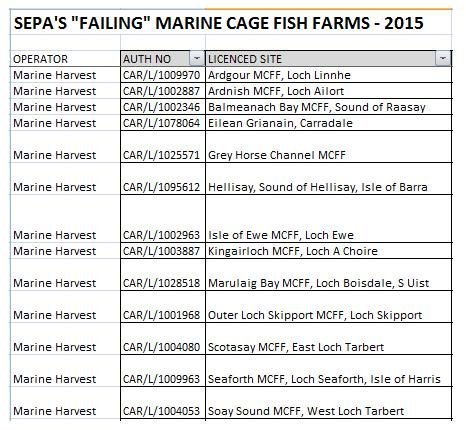
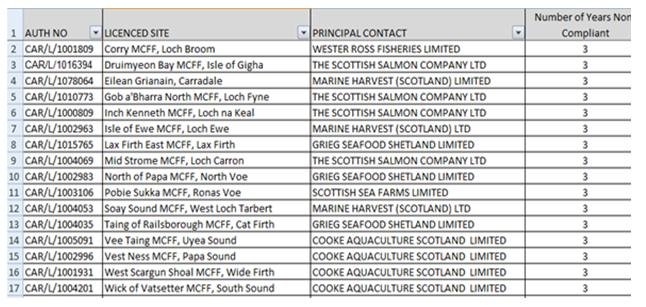
Download the non-compliance data for 2011-2015 as an Excel spreadsheet online here
In November 2016, the Ferret published the following table of "Scotland's polluting industries" with fish farms ranked 2nd worst:
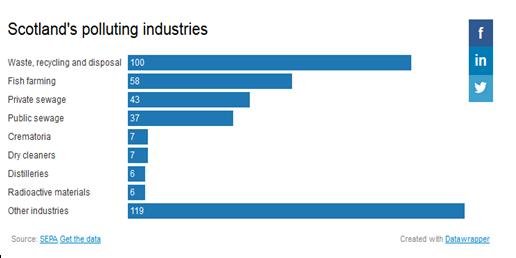
Read more via "Exposed: the 383 plants that pollute Scotland" and "Mapped: the hundreds of firms condemned for ‘poor’ pollution performance"
Download press release and media backgrounder as a PDF online here
How many fish farms have failed environmental rules since 2011 & which companies have the worst record? Data is published online but it's now dated – does new data exist or was it hacked by cyber-terrorists? https://t.co/5GE4Q8xGWk @ScottishEPA @SSPOsays @robedwards53 @scotgp pic.twitter.com/dgX9vOqOeW
— Don Staniford (@TheGAAIA) October 19, 2021
- Times: "Fears for environment as more fish farms fail to comply with standards"
- BBC News: "One in five Scottish fish farms 'not meeting standards'"
- BBC Good Evening Shetland on Failing Fish Farms
- BBC Radio Scotland's 'Newsdrive' on Failing Fish Farms
- Marine Harvest’s ASC-certified site ranked ‘poor’ in 2016 environmental protection report
- Shetland News: "Isles salmon farms rated 'poor' by SEPA"
- P&J: "Salmon farms accused of poor environmental practices"
- Failing Fish Farms: Scotland's Worst Salmon Farms Named & Shamed
- Failing Fish Farms – 18% rated "poor" by SEPA in 2015