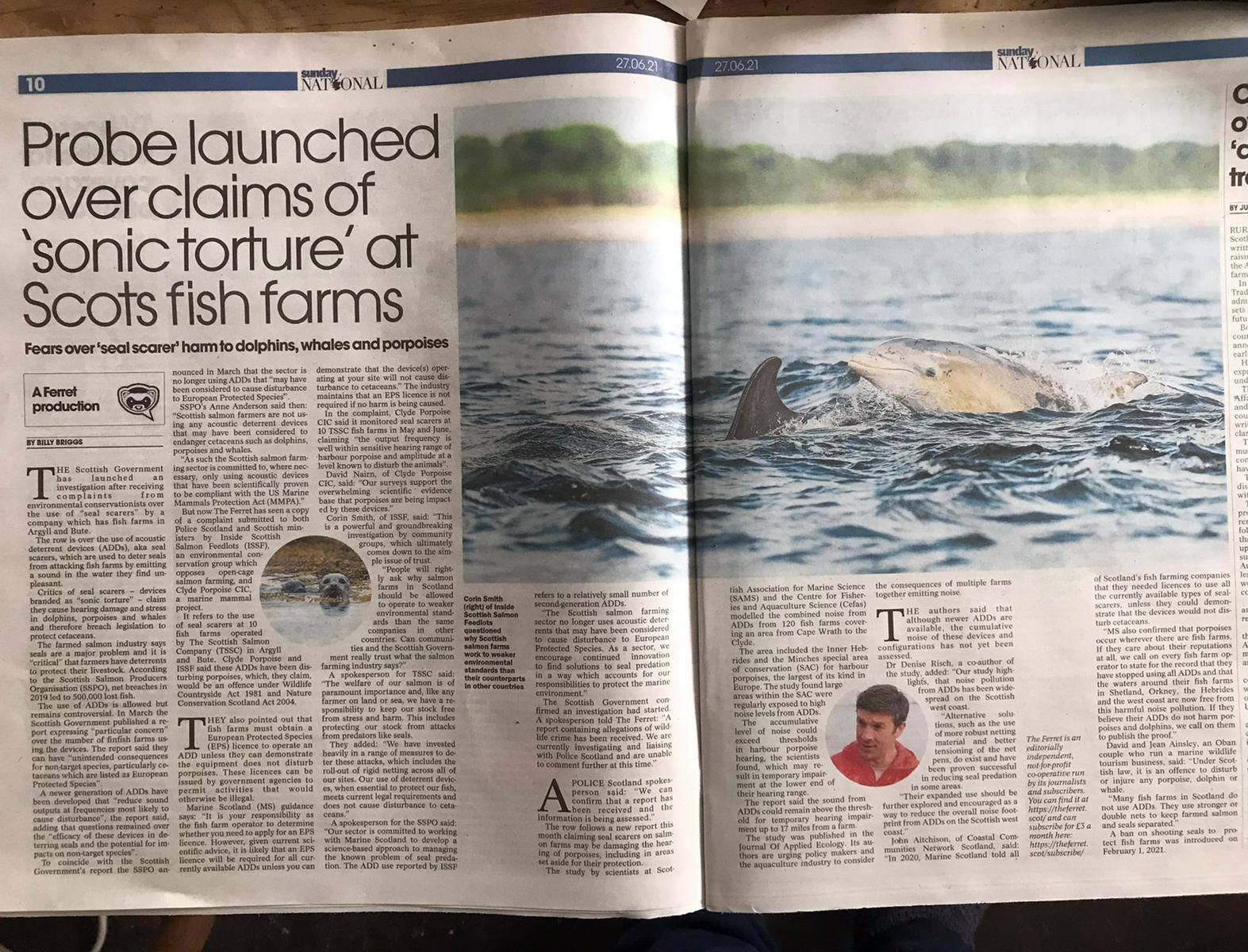
Probe launched over claims of ‘sonic torture’ at Scots fish farms @ScotNational @FerretScot @ClydePorpoise
"Can communities and the Scottish Government really trust what the salmon farming industry says?" @salmon_scottish @SSPOsays @marinescotland https://t.co/1eoZNmbW7X— Don Staniford (@TheGAAIA) June 27, 2021
The Sunday National and The Ferret reported (27 June 2021):
The Scottish Government has launched an investigation after receiving complaints from environmental conservationists over the use of “seal scarers” by a company which has fish farms in Argyll and Bute.https://t.co/L6BoQ7qAsN
— The Ferret (@FerretScot) June 27, 2021
A Scottish Government spokesperson told The Ferret: “A report containing allegations of wild life crime has been received. We are currently investigating and liaising with Police Scotland and are unable to comment further at this time.”https://t.co/L6BoQ7qAsN
— The Ferret (@FerretScot) June 27, 2021
Read more via The Sunday National: "Probe launched over claims of ‘sonic torture’ at Scots fish farms"
'People will rightly ask why salmon farms in Scotland should be allowed to operate to weaker environmental standards' https://t.co/46UrHV70wD
— Sunday National (@SunScotNational) June 27, 2021
Inside Scottish Salmon Feedlots issued a press release and video footage yesterday (28 June 2021) exposing the continued use of Acoustic Deterrent Devices by salmon farms across Scotland:
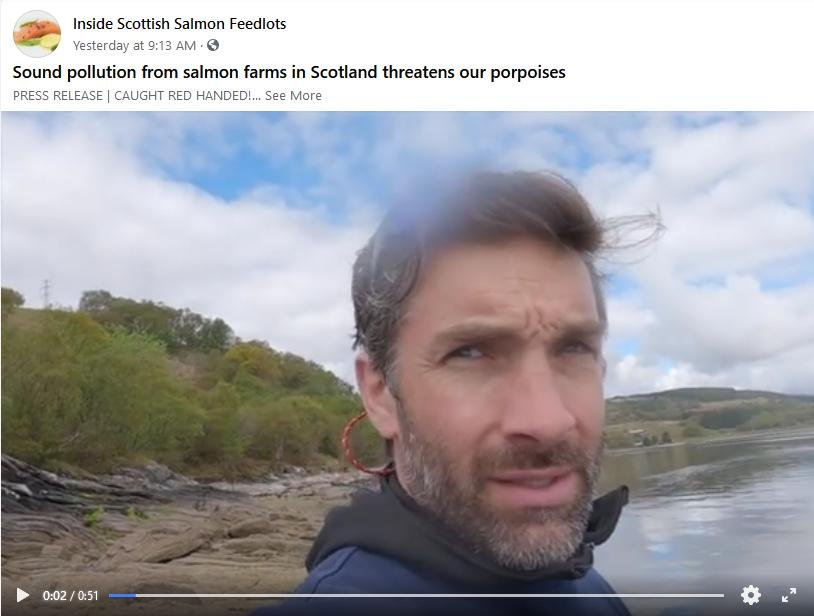
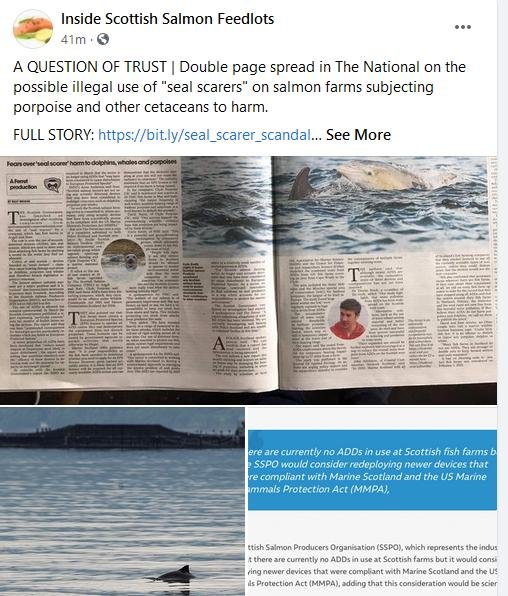
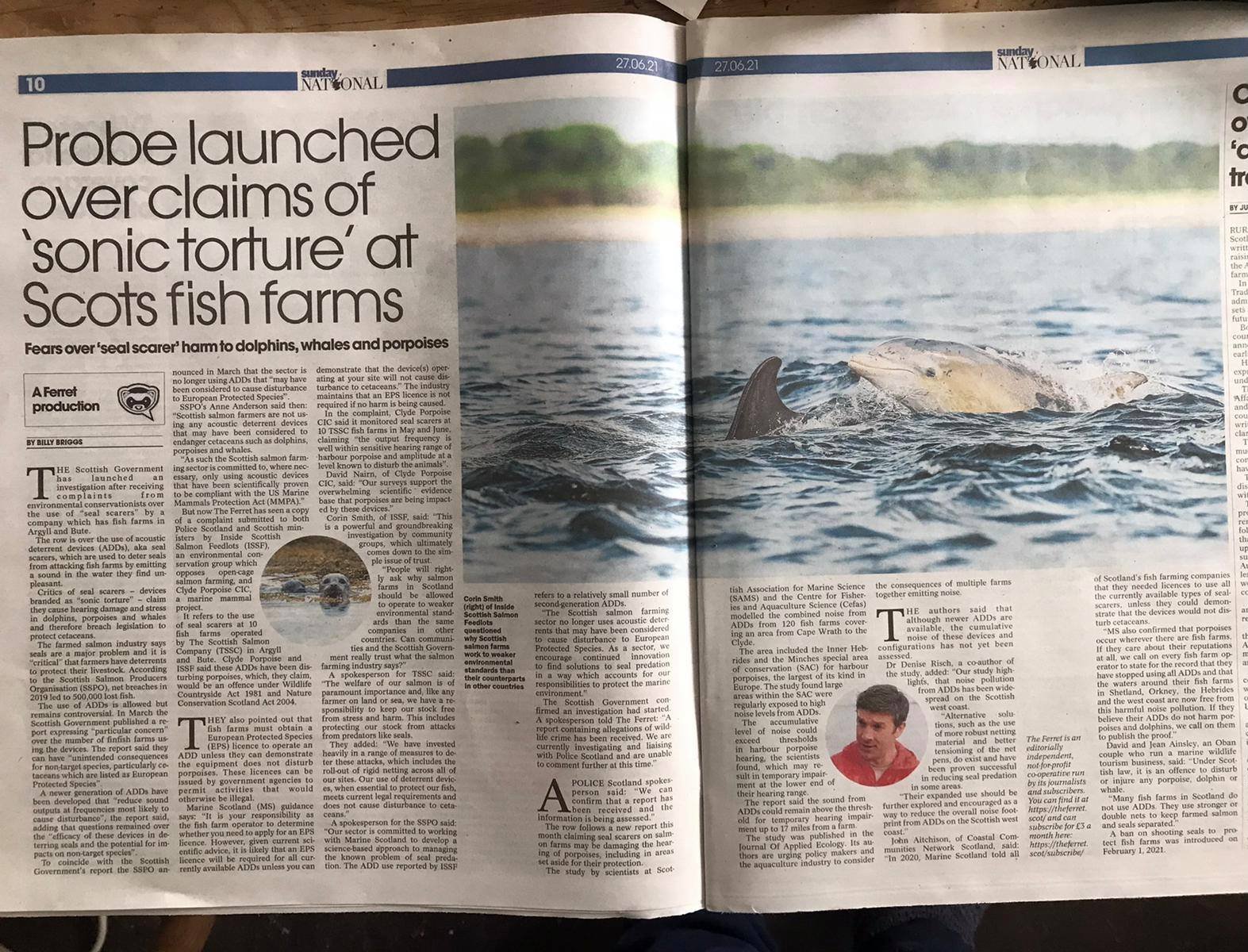
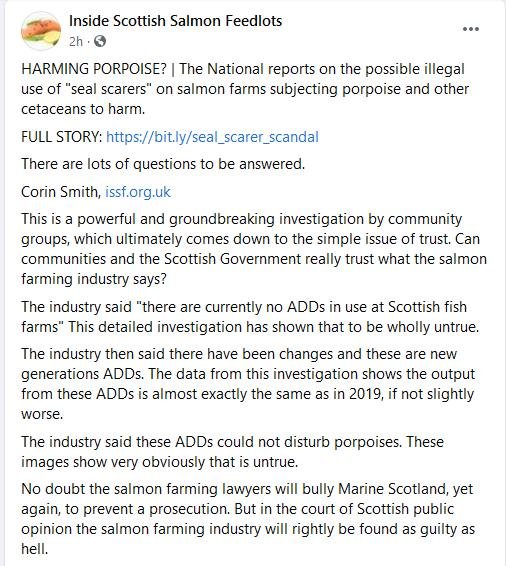
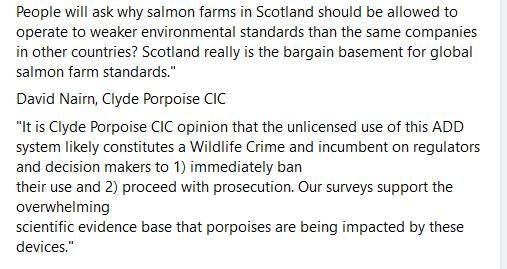
"In the court of Scottish public opinion the salmon farming industry will rightly be found as guilty as hell" (Corin Smith of Inside Scottish Salmon Feedlots) https://t.co/wcTHtY3oSO @ClydePorpoise @chazz_findlay @SealifeA @whalesorg @dolmansarahj @salmon_scottish @SSPOsays pic.twitter.com/sGklVbyfqu
— Don Staniford (@TheGAAIA) June 29, 2021
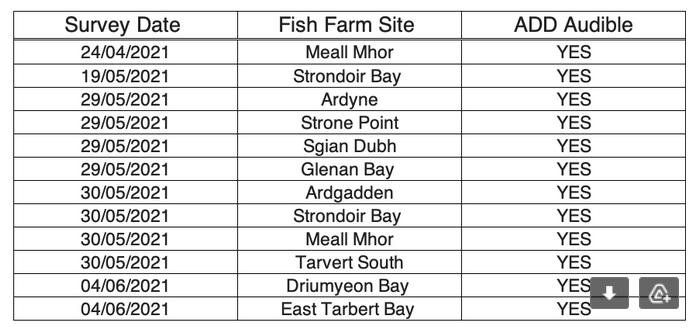
Surveying for Acoustic Deterrent Devices in Loch Fyne & Loch Striven found almost every active salmon farm using ADDs. Every farm was operated by Faroese/Norwegian-owned 'Scottish' Salmon Company @salmon_scottish @Folketrygdfond @Try_Lochlander @SSPOsays https://t.co/wcTHtY3oSO pic.twitter.com/J6zsOzrzOA
— Don Staniford (@TheGAAIA) June 29, 2021
Read more via:
- The Oban Times: "Seal scarer devices may harm harbour porpoise"
- "Five out of the six top farms in Scotland" use GenusWave's 'Acoustic Startle Technology' – But is it MMPA compliant & does it comply with EU law?
- "Scientists sound warning over next-gen seal scarers"
- Journal of Applied Ecology: "Auditory impairment from acoustic seal deterrents predicted for harbour porpoises in a marine protected area"
- Fish Farmer: "Seal scarers could harm porpoises, study finds"
- Parliamentary Report: "ADD Use in the Aquaculture Sector"
- Scientific Study into Impact of Low Frequency ADDs Silenced!
- Pulling the Plug on ADD on salmon farms – is turning down the volume enough to comply with the law?
- Sunday Times: "Animal welfare campaigners sound out ban on acoustic seal deterrent"
- Mail On Sunday: "Salmon farmers are 'torturing' porpoises and dolphins with high-pitched noises to protect their stock, campaigners warn"
- Unlicensed use of ADDs in aquaculture is contrary to European Protected Species legislation & completely immoral!
- Daily Record: "Whales and dolphins being 'tortured' by anti-seal scare devices at Scottish fish farms"
- The Guardian: "Scottish salmon farmers to be banned from shooting seals"
- Caught Between the Devil & the Deep Blue Sea
- The Ferret: "Seal scarers used by fish farms branded 'sonic torture'"
- GenusWave 'Targeted Acoustic Startle Technology' – in compliance with the U.S. Marine Mammal Protection Act??
- Seal shooting at salmon farms doubles before ban
- Ban on seal shooting must be watertight
- Greens want ban on seal scarers
- BBC Countryfile on ADDs impacting on cetaceans
- Sounding Off On Salmon Farms – Acoustic Deterrent Devices evade Marine Noise Registry
- SARF report 112: "Influences of lower-frequency Acoustic Deterrent Devices (ADDs) on cetaceans in Scottish coastal waters"
- The Times: "Noisy fish farms ‘harm other marine life’"
- Mapping widespread and increasing underwater noise pollution from acoustic deterrent devices
- Sounding Off About Scotland's Noisy Salmon Farms – Turn Off Acoustic Deterrent Devices to Protect Cetaceans
- Deafening Impact of Salmon Farms on Cetaceans
- The National: "Warning salmon farm devices could hit wildlife tourism"
- Turning Down the Volume on Salmon Farms is Not Enough: 'Cetacean Friendly' Acoustic Deterrent Devices Still Harm & Must Be Banned
- Cetaceans Sound Alarm On Salmon Farms – new research sparks EC complaint & call to ban Acoustic Deterrent Devices
- Sunday Herald: "Health of whales, dolphins and porpoises put at risk by underwater alarms"
- Noisy Salmon Farms – Switch Off Acoustic Deterrent Devices Now!
"Five out of the six top farms in Scotland" use GenusWave's 'Acoustic Startle Technology' – but is it MMPA compliant & does it comply with EU law?https://t.co/Mnc3yvlWby @NOAA @marinescotland @MairiMcAllan @MairiGougeon @SSPOsays @chazz_findlay @denrisch @SAMSoceannews @EU_ENV pic.twitter.com/PIcWYW6DXI
— Don Staniford (@TheGAAIA) June 9, 2021
What do you mean exactly by "2nd Gen ADDs"? Are you talking about GenusWave? https://t.co/EicHbeiBB8
— Don Staniford (@TheGAAIA) June 29, 2021
Can we trust the SSPO? Are they unaware that Gotz 2020 recorded startle reflex in bottlenose dolphins from a simulated 2nd generation device. Also Todd 2021 calculated large areas of TTS and PTS (hearing injury) for 6 commercial ADDs including 2nd generation GenusWave.
— Sealife-Adventures (@SealifeA) June 30, 2021
I have repeatedly asked for technical information related to these ADDs but none forthcoming. The onus of responsibility rests with operators and your members. It is not about 'balance'…. Its about the law!
— david nairn (@ClydePorpoise) June 30, 2021
Surely you're not suggesting salmon farmers knew nothing about ADDs breaching EU law? Tourist operator David Ainsley has been carping on about breaches of Scottish & European law for at least a decade. Did you not read his briefing @ScotParl @SP_ECCLR ? https://t.co/fUrpO6rtPO pic.twitter.com/kAZlmuOGvL
— Don Staniford (@TheGAAIA) June 30, 2021
It seems you're passing the buck onto ADD manufacturers for selling illegal devices or lying about their impacts on cetaceans. Surely @marinescotland @JNCC_UK & @nature_scot are complicit in turning a blind eye to EU law being broken? This smacks of VW's Dieselgate #ADDgate pic.twitter.com/Z73pbk5Zfp
— Don Staniford (@TheGAAIA) June 30, 2021
Todd 2021https://t.co/LSePbstRI3
— Sealife-Adventures (@SealifeA) June 30, 2021
At the end of the day – call it Judgment Day – any ADD designed to scare off seals will inevitably displace cetaceans. Surely we're just talking about zone of impact & level of disturbance? Even if '2nd Gen' ADDs are less noisy they still disturb & by definition break the law! pic.twitter.com/JuPMrIEb5F
— Don Staniford (@TheGAAIA) June 30, 2021
SNH (now Nature Scotland) concluded back in 2017 that ADDs caused disturbance of cetaceans (not to mention more recent scientific evidence detailing displacement). When you use the phrase "prove it beyond doubt" are you inviting legal action? https://t.co/c2iMwuVUzp pic.twitter.com/hrePqHc9O1
— Don Staniford (@TheGAAIA) June 30, 2021
Is this '2nd Generation' noise OK to cetaceans then?
Whisper it quietly but I heard a rumour from Bananarama that the manufacturers turned down the volume from #10 to #7 so now it's like listening to Rod Stewart, Susan Bolyle & Lewis Capaldi instead of Biffy Clyro or ACDC pic.twitter.com/r6sYiCyzJn— Don Staniford (@TheGAAIA) July 2, 2021