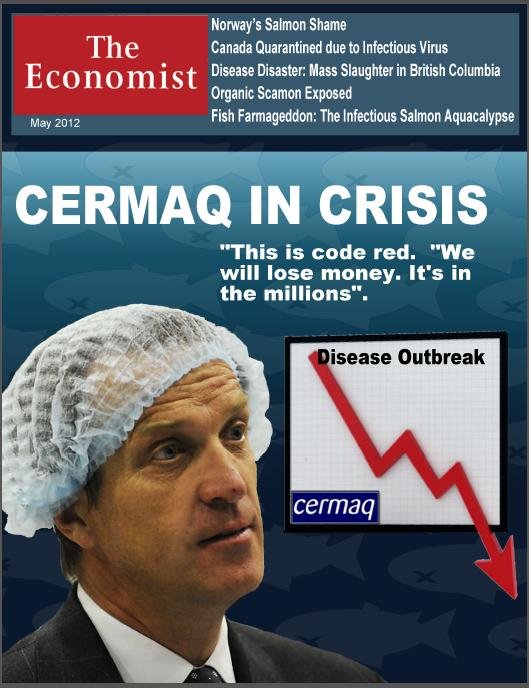
Cermaq's CEO Jon Hindar was left red-faced again today as the financial consequences of poor disease management in both Norway and Canada returned to haunt the world's second largest salmon farming company.
"Cermaq's Operations Went to Zero in Third Quarter" reported Norway's Nettavisen (23 October).

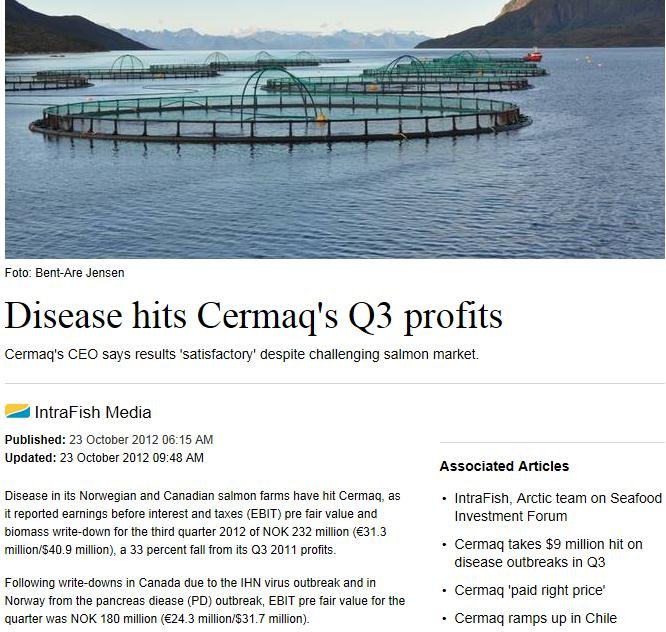
Intrafish, Norway's daily news service for the salmon farming industry, reported (23 October):
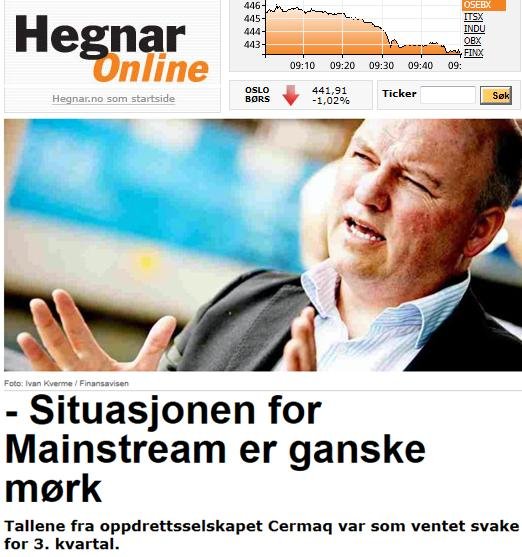
"Mainstream Situation is Quite Dark," reported the Norwegian financial media (23 October).
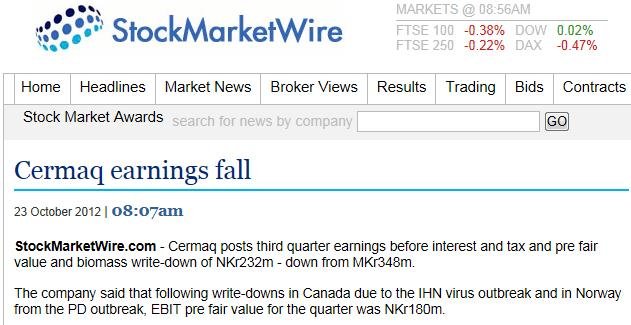
Stock Market Wire reported (23 October):
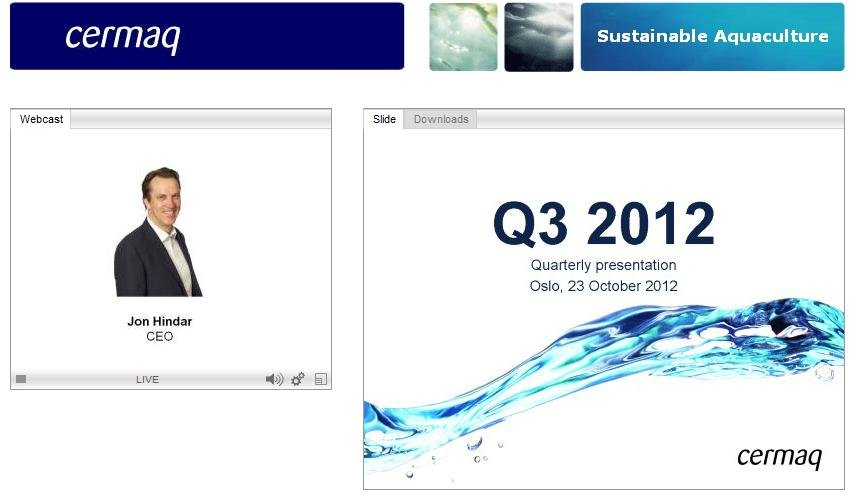
"Q3 2012 was very
challenging," conceded Cermaq’s CEO Jon Hindar in a live web-cast this morning from Oslo, Norway.
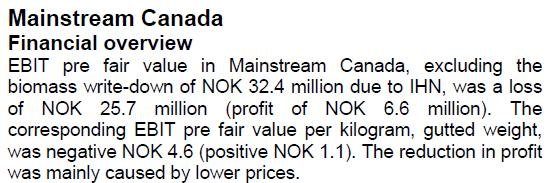
Cermaq's Q3 2012 financial results detailed disease losses of NOK 52 million – including NOK 33 million due to the spread of Infectious Hematopoietic Necrosis (IHN) in the Clayoquot Sound UNESCO Biosphere Reserve in Canada and NOK 19 million in Norway due to Pancreas Disease (PD).
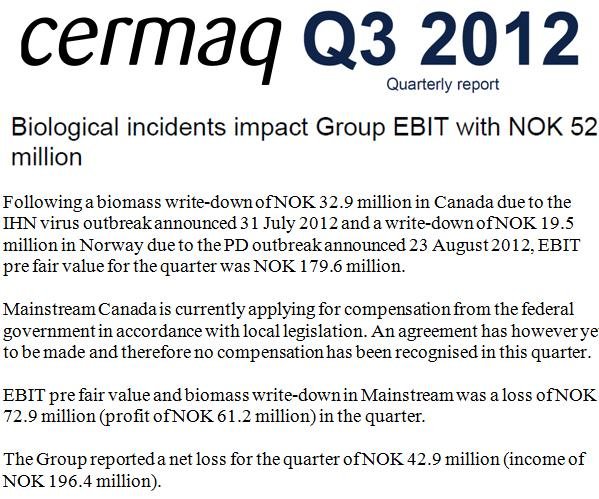
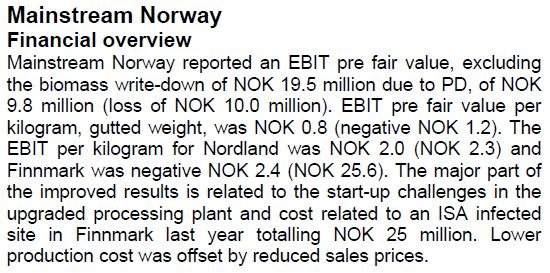
Cermaq's Q3 2012 financial report included the following for Norway and Canada:
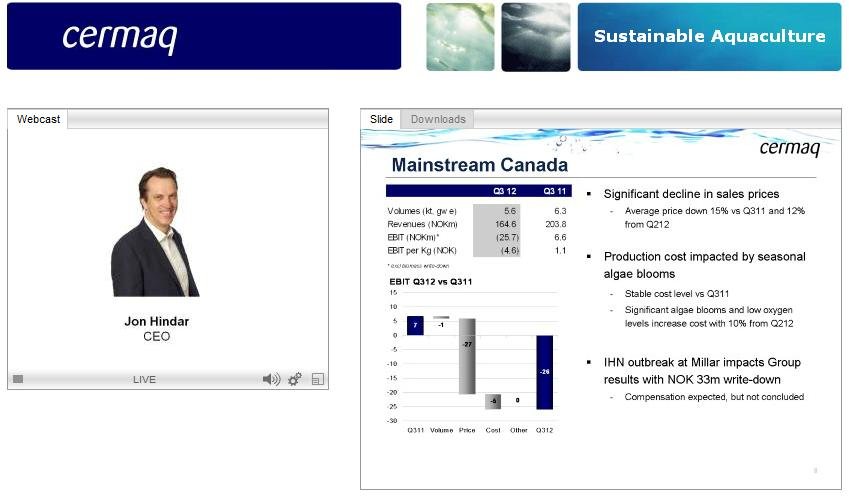
"Discussions are underway with
the authorities regarding compensation for IHN in Canada,” said Cermaq’s CEO during the Q3 2012 live web-cast. “We have a very good dialogue but discussions
have not been concluded."
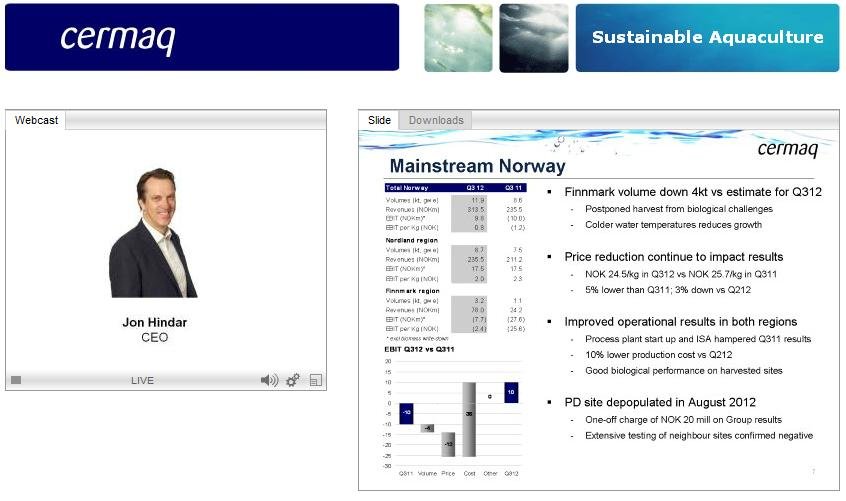
Cermaq's CEO also reported disease problems in Norway:
View the Q3 2012 presentation in full online here
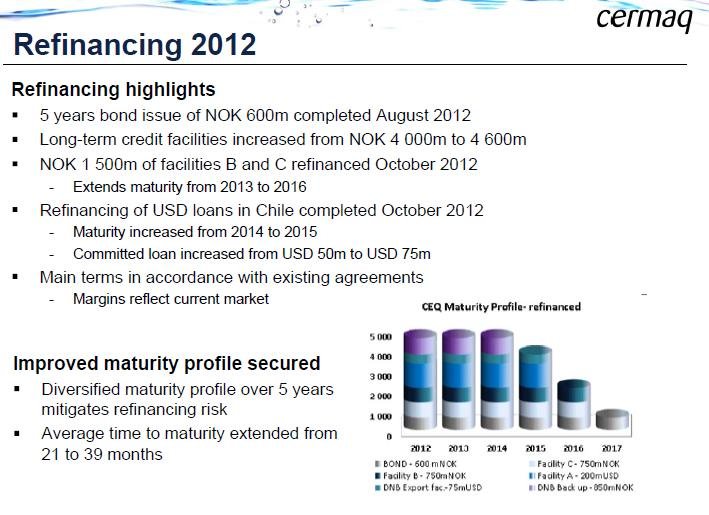
Cermaq also announced a "refinancing" of their long term credit facilities. "Cermaq ASA has signed a term sheet with Danske Bank, DNB, Handelsbanken and Nordea to refinance two of its credit facilities amounting to a total of NOK 1.500m," reported 4-Traders (23 October). "The final loan agreement is expected to be in place by the end of 2012, and the funds will be used for general corporate purposes, to support Cermaq's growth strategy."

Cermaq's Q3 2012 presentation also gave more details of the refinancing package:
Faced with mounting disease problems in Canada and Norway, Cermaq is gambling on expansion in Chile where 55% of the company's salmon farming activities are now located:
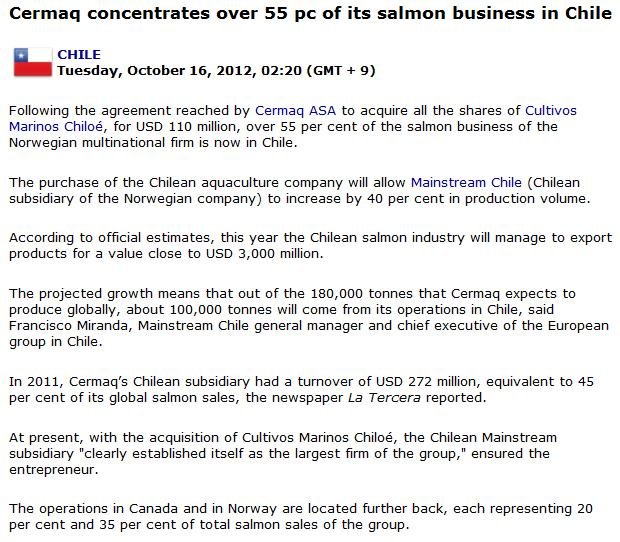
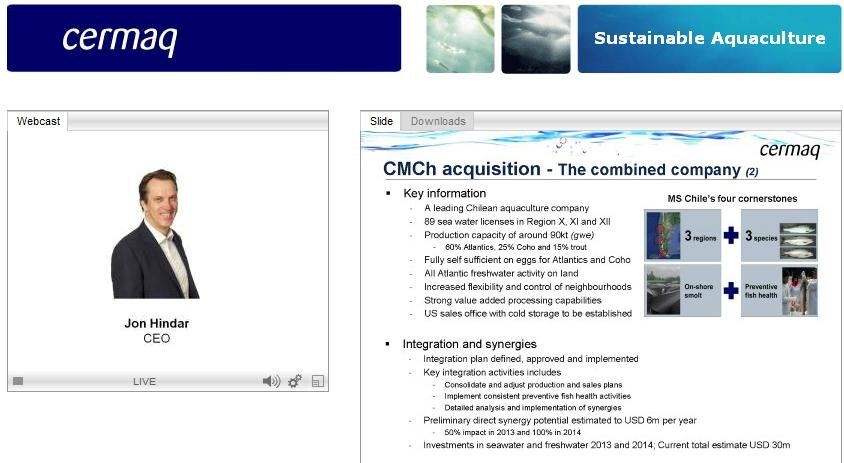
Cermaq's CEO Jon Hindar outlined their expansion plans in Chile via the live web-cast and Q3 2012 presentation.
Expansion in Chile is by no means a panacea for Cermaq's disease problems. Cermaq has lost millions in Chile due to the spread of infectious diseases – including sea lice, SRS and Infectious Salmon Anaemia (read more via a letter to Cermaq in May 2011 - online here).
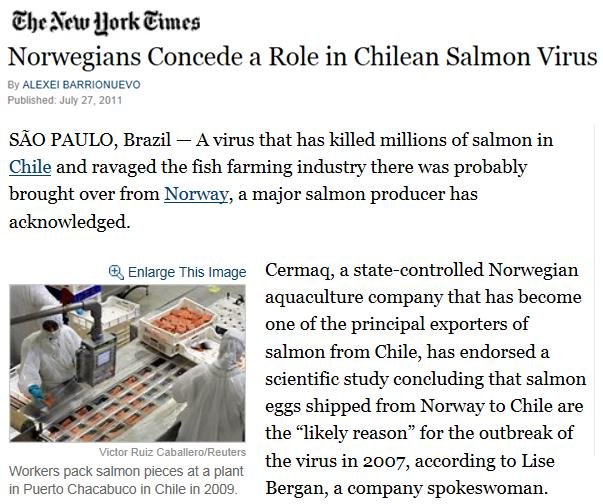
The New York Times reported
last year that Cermaq had conceded the role played by Norwegian companies bringing Infectious Salmon Anaemia (ISA) from Norway to Chile. The spread of the deadly disease prompted calls in Chile for compensation from the Norwegian Government and Norwegian salmon farming industry.
For more on the disease problems crippling the global salmon farming industry read "Fish Farmageddon: The Infectious Salmon Aquacalypse"

Photo: Mortalities at Cermaq's farm at Warn Bay in Clayoquot Sound
Follow the money!

Here's the shareholders in Cermaq (including the Norwegian Government, Goldman Sachs, JP Morgan Chase, State Street Bank, Bank of New York and the Statoil Pension Fund):
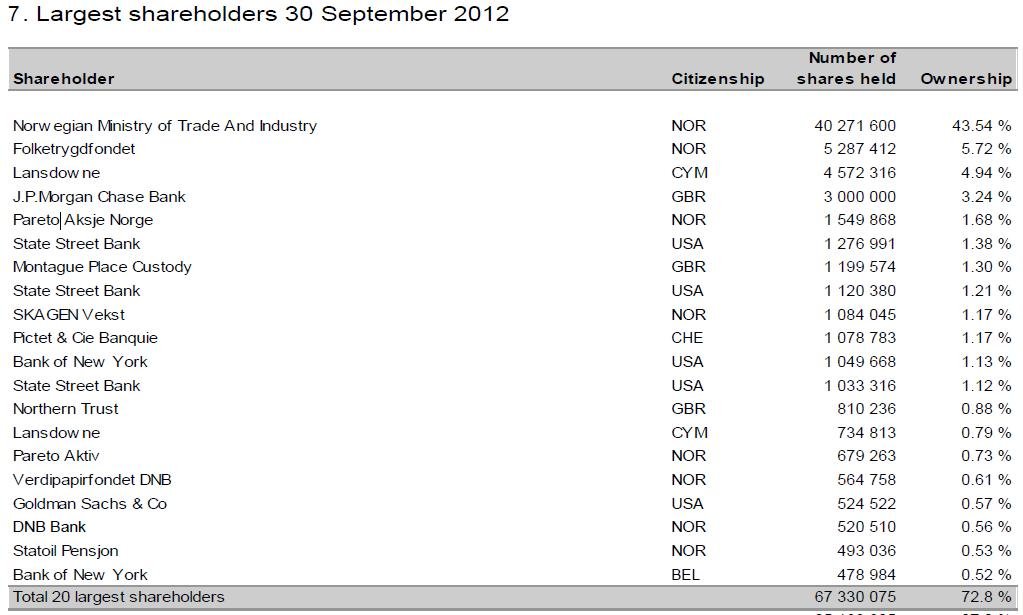
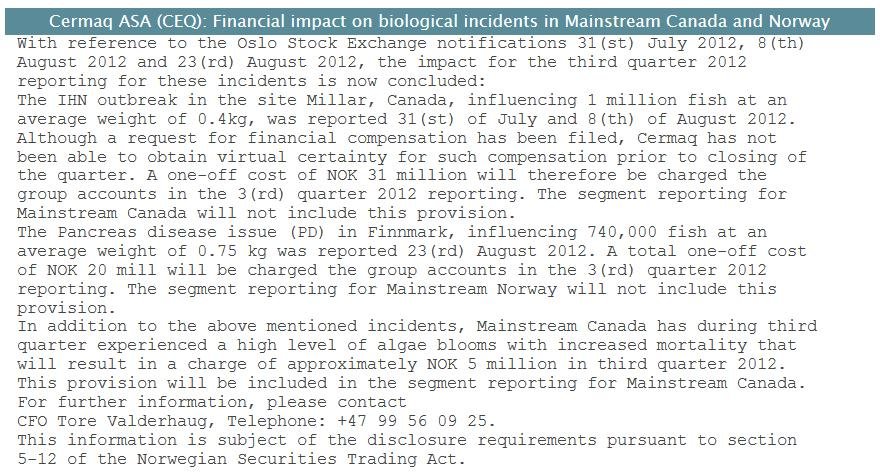
As infectious diseases go viral, shareholders in Cermaq are becoming used to 'Stock Exchange Notifications' reporting on costly disease problems. Earlier this month (4 October, Cermaq reported:
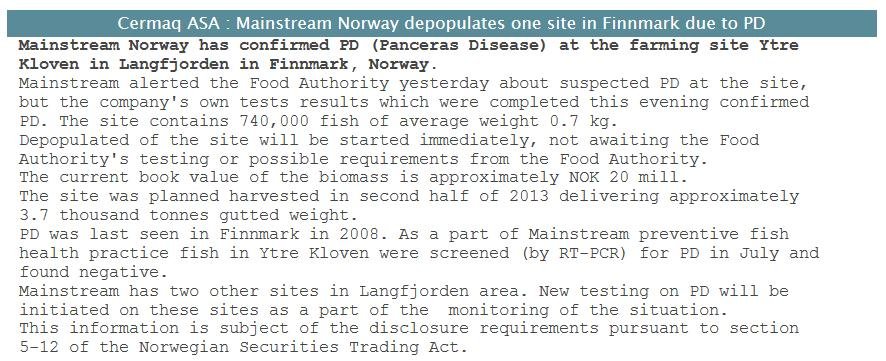
Cermaq reported in August 2012:
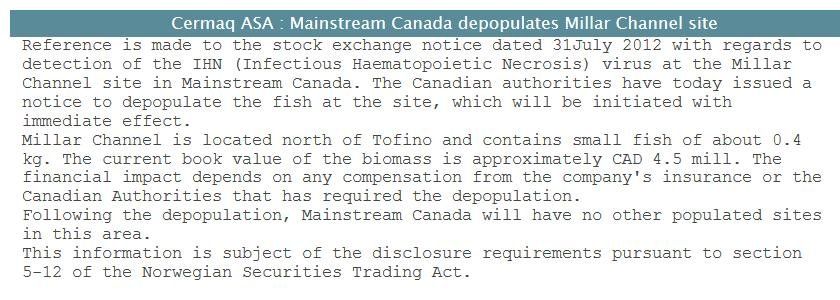
Cermaq also reported in August 2012:
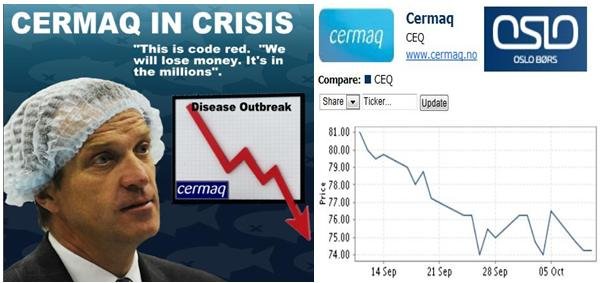
For more background on Cermaq's disease losses read "Diseases Cost Cermaq Millions"
Cermaq's claim for compensation due to disease losses in the Clayoquot Sound UNESCO Biosphere Reserve has attracted growing criticism.
"How’s this for a business model: You bring together thousands of
fish, stick them in an open net in the ocean, despite warnings that the
conditions invite infectious disease, and then, when they all get sick,
you receive compensation from the Canadian taxpayer," wrote Andrew Gage at West Coast Environmental Law (14 August).

"So why would fish farm companies be able to claim compensation for losses through disease?" continued Gage. "Even if you buy their line that these diseases were spread from wild fish (the Friends of Clayoquot Sound have data that suggests otherwise),
these companies, and not the Canadian taxpayer, made the choice to have
Atlantic salmon in open net farms in waters infested by wild salmon
with their yucky diseases, and apparently made the choice not to vaccinate them against those diseases."

"A bailout for these losses would mean that they don’t even have to
pay for losses that come with open net salmon farming, and as such
represents a direct subsidy to what many, including West Coast
Environmental Law, believe to be an unsustainable industry," concluded
Gage. "These are very large companies, with private insurers. They can
afford to pay for the costs of their own choices. We believe that the
law should ensure that fish farm companies are responsible for the real
costs of their operations. Bailing out these companies would definitely
be a step in the wrong direction."
Read more via "Will your tax dollars subsidize BC’s unsustainable fish farms?" and "Compensation Culture"
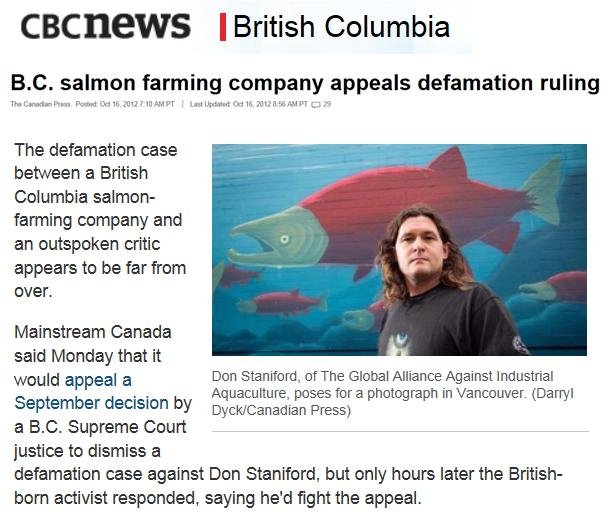
Cermaq is also facing mounting losses in Canada due to lawsuits. Last month Cermaq's subsidiary Mainstream Canada lost a defamation case in the Supreme Court of Canada. "Mainstream spokeswoman Laurie Jensen said the company had not yet tallied its costs," reported CBC News (16 October).
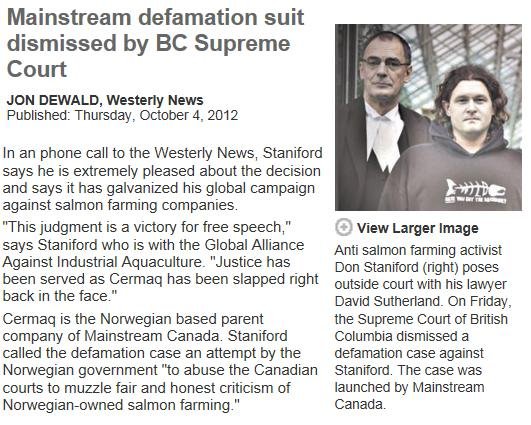
Cermaq's legal bills are rising as their SLAPP suit galvanises global opposition against the Norwegian-owned salmon farming industry. As The Westerly News reported (4 October 2012) following Cermaq's lawsuit loss in the Supreme Court of British Columbia:
Read more via "Cermaq
Like a Cancer Grows: The Sound of Cermaq’s SLAPP"
Further legal action Vs. Cermaq could be pending in Canada. "We will
not allow governments and industry to run roughshod over our rights to
clean water
and sustainable fisheries," said Terry
Dorward, Tla-o-qui-aht Elected Councilor, in a press release (15
October). "We are investigating legal options and will not rule
out direct actions to stop Mainstream Canada’s Plover Point fish farm."
In January 2012, Terry Dorward was interviewed by Norwegian TV.
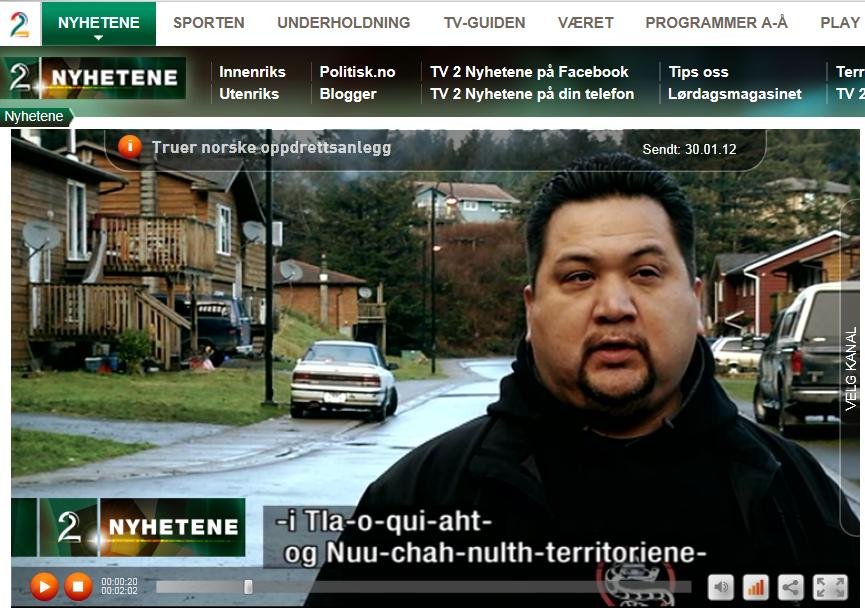
"We've been concerned about the impacts of salmon farming in
Tla-o-qui-aht and Nuu-chah-nulth territory and the impacts it has on our
coastal communities," said Dorward. "The impacts of fish farms, the
sea lice, the infectious diseases – we felt enough was enough. If the
governments are not going to do it, then I believe the people will. The
people will stand up. People will shut these farms down. It's that
much of an important issue that people will go and fill up those jails."
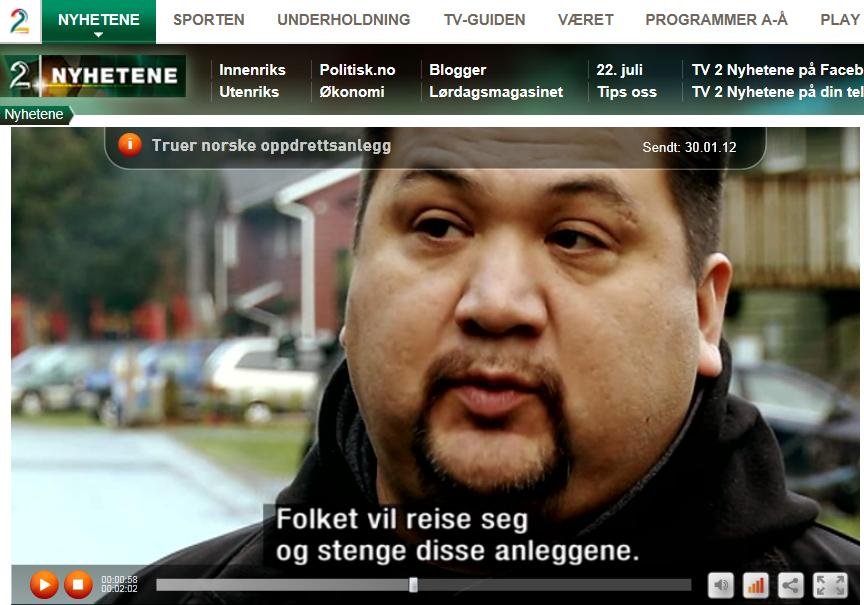
"The next level in my view, if the governmentand industry doesn't
listen, is we have to shut those farms down" continued Dorward.
Read more via "Legal Action Vs. Cermaq in Clayoquot?"