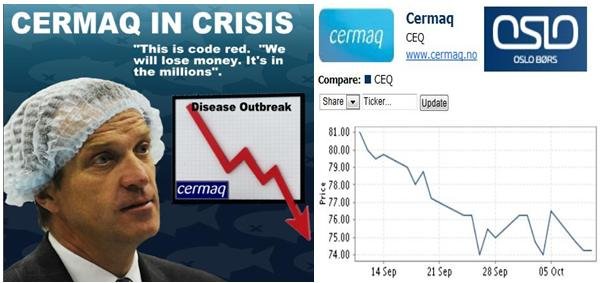
Infectious diseases in Canada and Norway are crippling the Norwegian Government-owned multinational corportation Cermaq.
"Cermaq Halved" reported Intrafish (19 October) as their CEO Jon Hindar struggles to tackle the escalating disease crisis.
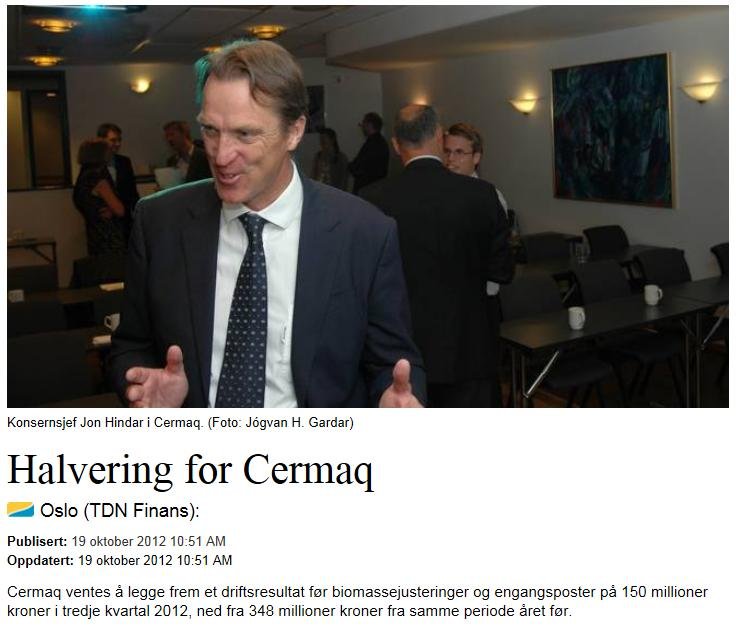
In Oslo on Tuesday (23 October), Cermaq's CEO Jon Hindar will present the disastrous Q3 2012 financial results to shareholders which include Norway's Ministry of Trade and Industry, JP Morgan Chase Bank, Bank of New York Mellon, Goldman Sachs and the Statoil Pension Fund. The false economy of salmon farming is difficult to ignore – listen to the Q3 presentation online here
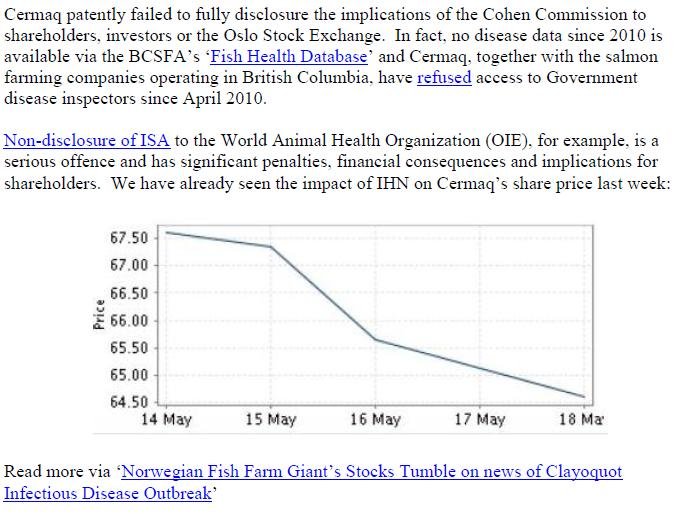
In a notification to the Oslo Stock Exchange (4 October), Cermaq revealed that infectious diseases accounted for losses of over NOK 50 million – including NOK 31 million for the spread of Infectious Hematopoietic Necrosis (IHN) in the Clayoquot Sound UNESCO Biosphere Reserve:
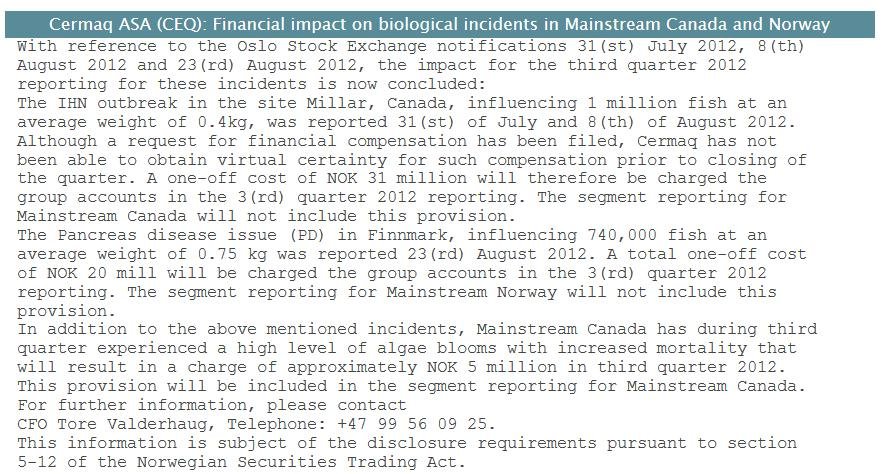
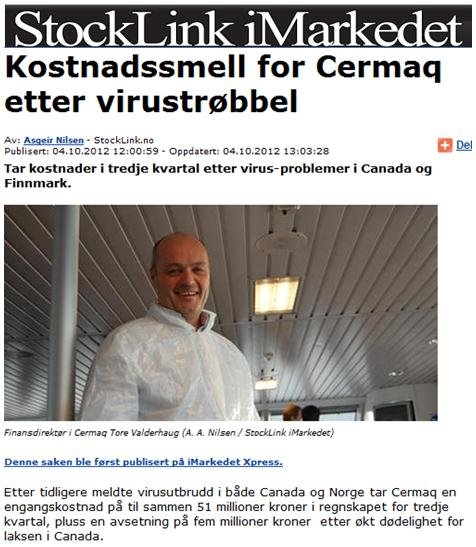
The Norwegian media reported Cermaq's financial misery via the headlines: "Cost Smell of Cermaq After Virus Trouble" and "Cermaq Blows 56 Million":
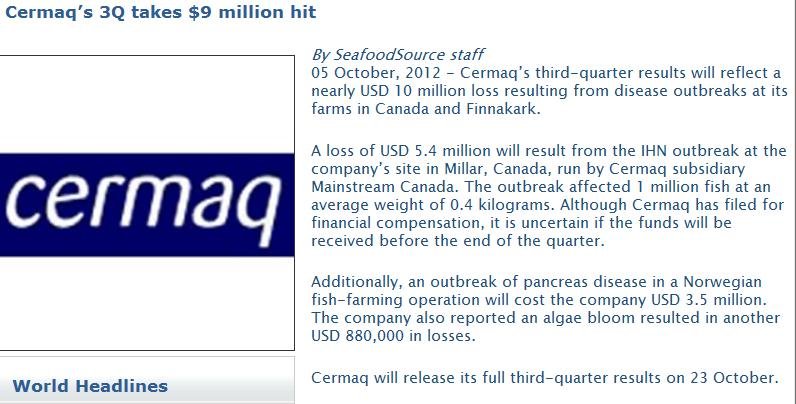
Seafood Source reported (5 October):
Cermaq's claim for compensation due to disease losses in the Clayoquot Sound UNESCO Biosphere Reserve has attracted growing criticism.
"How’s this for a business model: You bring together thousands of
fish, stick them in an open net in the ocean, despite warnings that the
conditions invite infectious disease, and then, when they all get sick,
you receive compensation from the Canadian taxpayer," wrote Andrew Gage at West Coast Environmental Law (14 August).

"So why would fish farm companies be able to claim compensation for losses through disease?" continued Gage. "Even if you buy their line that these diseases were spread from wild fish (the Friends of Clayoquot Sound have data that suggests otherwise),
these companies, and not the Canadian taxpayer, made the choice to have
Atlantic salmon in open net farms in waters infested by wild salmon
with their yucky diseases, and apparently made the choice not to vaccinate them against those diseases."

Photo: Mortalities at Cermaq's farm at Warne Bay in Clayoquot Sound
"A bailout for these losses would mean that they don’t even have to
pay for losses that come with open net salmon farming, and as such
represents a direct subsidy to what many, including West Coast
Environmental Law, believe to be an unsustainable industry," concluded
Gage. "These are very large companies, with private insurers. They can
afford to pay for the costs of their own choices. We believe that the
law should ensure that fish farm companies are responsible for the real
costs of their operations. Bailing out these companies would definitely
be a step in the wrong direction."
Read more via "Will your tax dollars subsidize BC’s unsustainable fish farms?" and "Compensation Culture"
The current book value of the biomass is approximately CAD 4.5 mill,” stated Cermaq’s stock exchange notice
(8 August). “The financial impact depends on any compensation from the
company's insurance or the Canadian Authorities that has required the
depopulation. Following the depopulation, Mainstream Canada will have
no other populated sites in this area. This information is subject of
the disclosure requirements pursuant to section 5-12 of the Norwegian
Securities Trading Act.”

“As quarantine measures are in place, traffic around the farms will be restricted,” reported Mainstream Canada (8 August) via a press release.
“This is crucial to helping prevent the spread of virus to any other
farm sites in the area. Migrating wild salmon are natural carriers of
the IHN virus, and are most likely the source of the virus infection at both farms.”
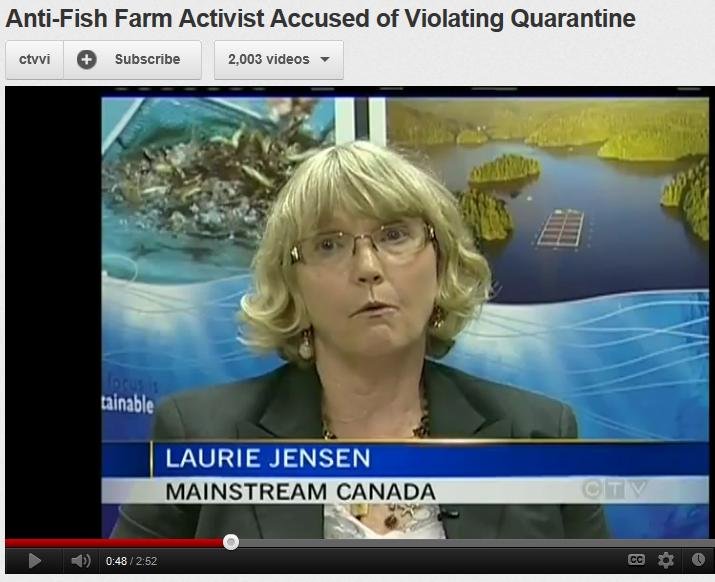
Watch CTV News on "Anti-Salmon Farm Activist Refutes Claims" and "Anti-Fish Farm Activist Accused of Violating Quarantine"
Cermaq reported via another stock exchange notice (11 July): “Total expenses in relation to depopulation and clean-up are calculated to NOK
27 million. Mainstream Canada is currently looking into the
possibility to obtain compensation either from the federal government or
its insurance provider. It has however not yet been possible to obtain
an agreement with the insurance company responsible for the biomass
insurance. In accordance with the IFRS requirement that a compensation must be virtually certain to be recognized in the profit and loss statement, Cermaq will therefore book a one time charge of NOK 27 million in the Group’s 2nd quarter 2012 report, to be published 20 July 2012.”
Cermaq is playing a dangerous
blame game. “Mainstream believes that wild fish are infecting their
farmed salmon,” says Friends of Clayoquot Sound executive director Dan Lewis in The Westerly News (9 August). “Many British Columbians are concerned that farmed salmon are transmitting deadly diseases to wild salmon.”
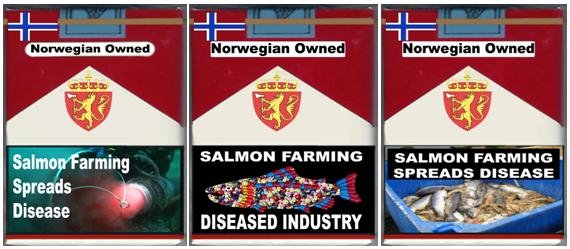
"Mainstream and the other
companies farming salmon on our coast do commit resources to environmental
testing and safety measures," writes Torrence Coste of the Wilderness Committee in today's Times Colonist (20 October). "But it just isn't possible for them to ensure that
viral outbreaks don't occur on their sites and, given the nature of an open-net
farm, spread into the surrounding marine environment. Everything in these sites
is transmittable to the surrounding waters – from food, feces and urine to
disease, fertilizers, hormones and even antibiotics."
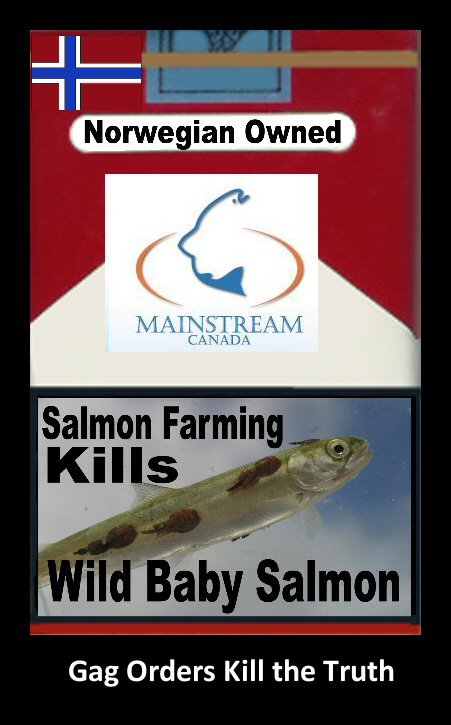
"If Norwegian-owned companies are found guilty of transmitting
deadly diseases to wild salmon then the floodgates could be opened to
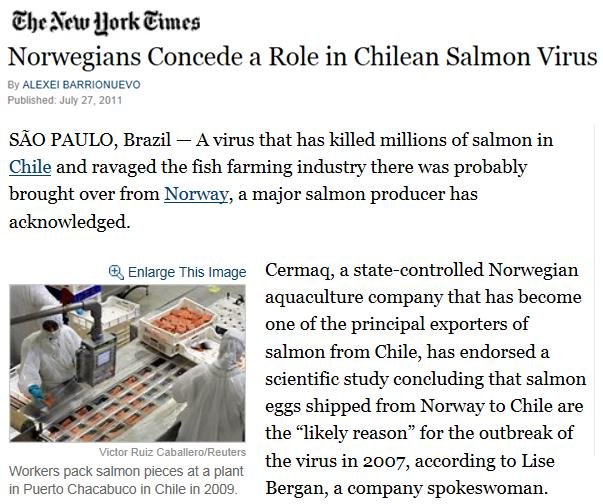
legal action and huge compensation claims," reported Superheroes 4 Salmon (9 August). "The New York Times reported
last year that Cermaq had conceded the role played by Norwegian companies bringing Infectious Salmon Anaemia (ISA) from Norway to Chile. The spread of the deadly disease prompted calls in Chile for compensation from the Norwegian Government and Norwegian salmon farming industry."
"ISA and another ‘Norwegian’ virus (piscine reovirus associated with Heart & Skeletal Muscle Inflammation) have already been reported in salmon farms in Clayoquot Sound as well as in farmed salmon on sale in supermarkets in British Columbia. Last month, CTV News reported on positive tests for ISA in farmed salmon in supermarkets."

Watch CTV News on ‘Deadly Fish Virus Detected’ (19 July) and ‘Lab tests suggest contagious salmon virus may be in B.C.’ (16 July)
In August 2012, Global News reported on a class action lawsuit
filed by First Nations relating to the Government’s failure to protect
wild salmon from infectious diseases such as sea lice. “The band
contends that fish farms allowed to operate net pens in the open ocean
off the northeastern tip of Vancouver Island caused an outbreak of sea
lice in their traditional fishing grounds, and sought financial
compensation for depleted wild salmon stocks,” reported CTV News (8 August) .
Cermaq is also facing the threat of a lawsuit following the approval of their Plover Point farm in the Clayoquot Sound UNESCO Biosphere Reserve.
"We will
not allow governments and industry to run roughshod over our rights to
clean water
and sustainable fisheries," said Terry
Dorward, Tla-o-qui-aht Elected Councilor, in a press release (15
October). "We are investigating legal options and will not rule
out direct actions to stop Mainstream Canada’s Plover Point fish farm."
"People will shut these farms down," said Dorward in an interview with Norwegian TV in January 2012. "It's that much of an important issue that people will go and fill up those jails."
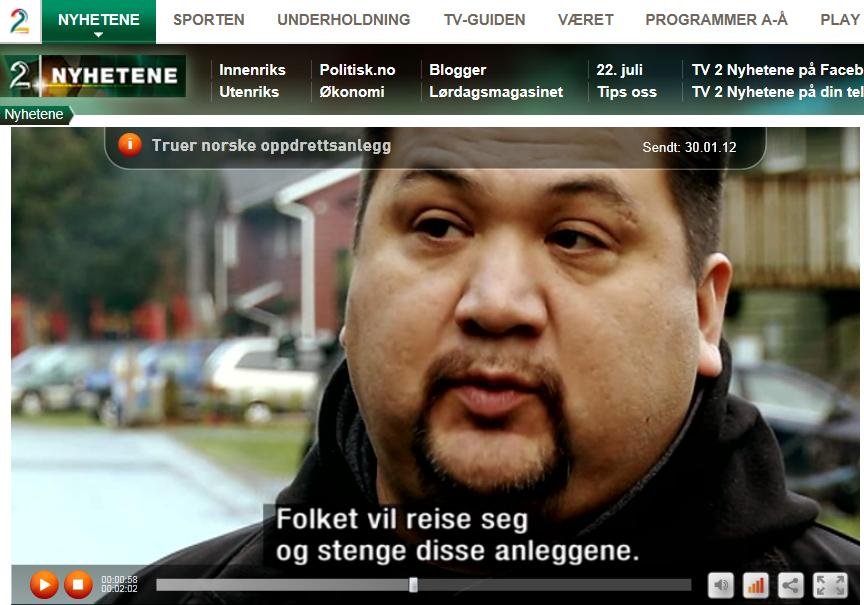
"The next level in my view, if the governmentand industry doesn't
listen, is we have to shut those farms down" continued Dorward.
Read more via "Legal Action Vs. Cermaq in Clayoquot?" and "Fish
farm approval sparks lawsuit threat"
Cermaq is facing further legal problems as the 'Salmon Farming Kills' lawsuit rumbles on. "No amount of
sabre-rattling, intimidation and bullying by this Norwegian Government-owned
corporation will alter the fact that salmon farming kills sea lions, spreads
infectious diseases and even results in the death of their own
workers," said Don Staniford (16 October) in response to Cermaq's appeal filed in the Court of Appeal (15 October).
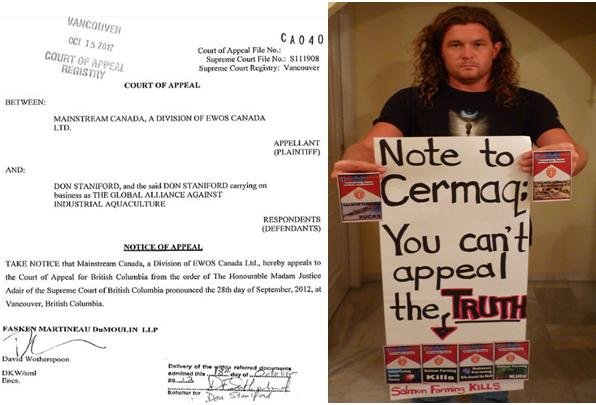
Read more via "Cermaq Dig Deeper Hole by Appealing Lawsuit Loss"
If Cermaq's appeal is successful the statement "Salmon Farming Spreads Disease" could be deemed illegal. Cermaq's 'Notice of Civil Action' filed in March 2011 claimed that the following were 'Defamatory Words':
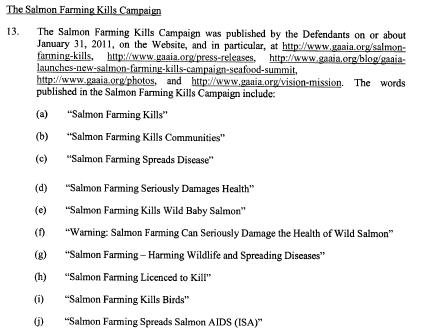
Read in full online here and more details via "Norway’s
Injunction Kills Free Speech!" and "Gagging the Truth
Becomes Mainstream"
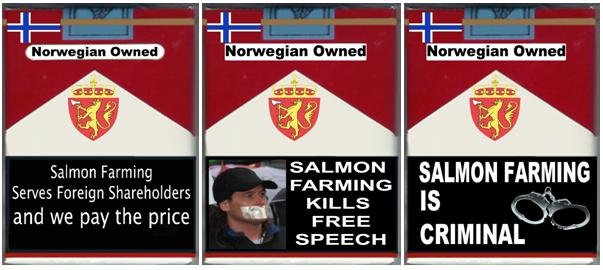
The stakes are certainly high. Last year, The Common Sense Canadian
revealed that Norwegian-owned salmon farming companies operating in British Columbia would suffer
“undue financial loss” and “significant commercial harm” if disease data
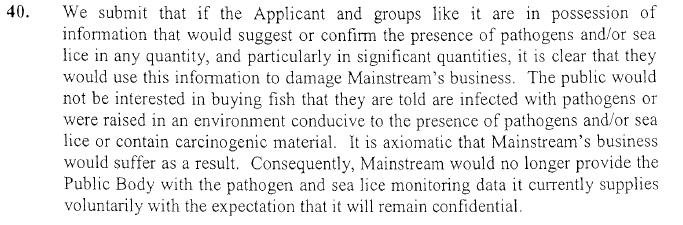
was disclosed to the public. Cermaq claimed in a submission to the Office of the Information & Privacy Commissioner in 2008 that “disclosure would “damage Mainstream’s business” and referred to “the harm which such information in the wrong hands can do.”
The letter from Cermaq's lawyers Fasken Martineau included:
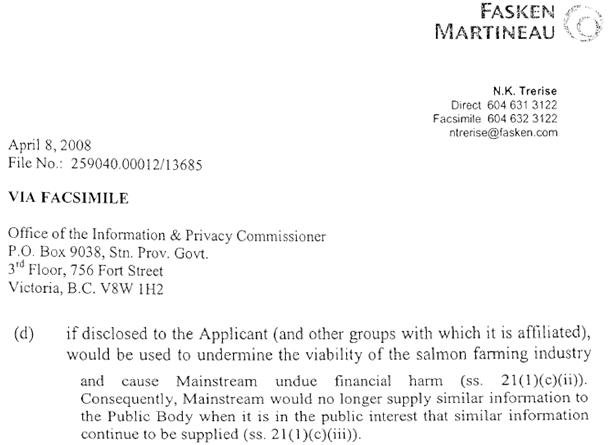
The letter also included:
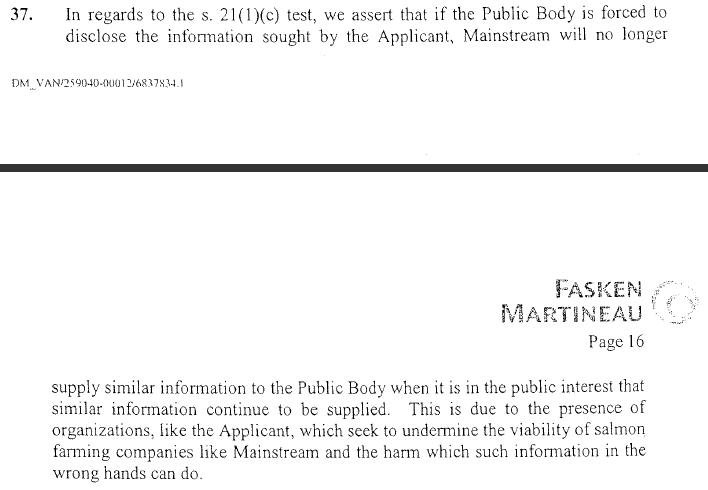
Moreover, Cermaq admitted that the disclosure of disease information would stop people buying farmed salmon:
Read the letter from Cermaq's lawyers in full online here
“When does a foreign-owned corporation’s
right to protect its share price trump the environment and Canadian
public’s rights?” wrote The Common Sense Canadian. “Apparently, when
it’s the Norwegian salmon farming industry."

"If and when compelling new evidence comes to bear – on the public record, there for media to freely report – connecting BC’s declining salmon populations with diseases related to the salmon farming industry, the fall-out for the industry could indeed be as severe as it fears," continued The Common Sense Canadian.
"Those flashy TV ads professing the industry’s utter innocence would certainly come back to haunt it, as would all the years of obstructing the communication of important science to the public whose wild salmon and marine environment are at stake. After all, as Watergate taught us, “it’s not the crime, it’s the cover-up.” Is the Norwegian salmon farming industry in line for a Nixonian fall?"
Read more via ‘Farmed Salmon Confidential’
Cermaq was forewarned of the financial risks of infectious diseases in British Columbia. Last year, Cermaq’s
Board of Directors, Oslo Stock Exchange, shareholders and financial
analysts were all notified of the disease risks.
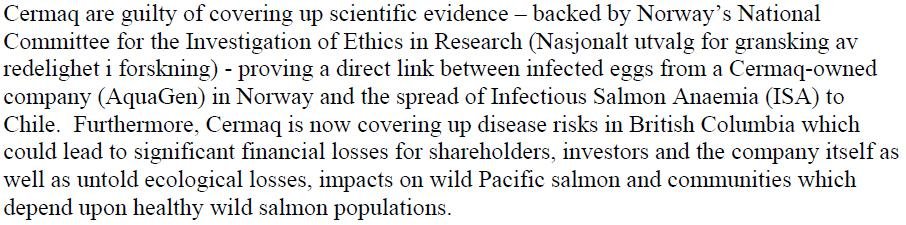
"Cermaq’s Board of Directors and Cermaq’s Corporate Management Team have exhibited a woeful lack of transparency to both shareholders and investors and may be in breach of the disclosure and reporting requirements to the Oslo stock exchange," stated the letter from GAAIA. "Furthermore, Cermaq is now covering up disease risks in British Columbia which could lead to significant financial losses for shareholders, investors and the company itself as well as untold ecological losses, impacts on wild Pacific salmon and communities which depend upon healthy wild salmon populations."
The letter also stated:
Read the letter (May 2011) from GAAIA in full online here
In May this year another letter was sent to Cermaq's CEO Jon Hindar regarding the non-disclosure of disease data (read more via ‘Cermaq in Crisis in Canada’).
"Cermaq ignores the situation in Canada at its peril and is derelict in its duty to shareholders and to the Oslo Stock Exchange (Børs)," stated the letter from GAAIA. "The lack of transparency in terms of disease reporting for Cermaq’s Canadian operations is alarming."
The letter also included:
Read the letter from GAAIA (May 2012) in full online here
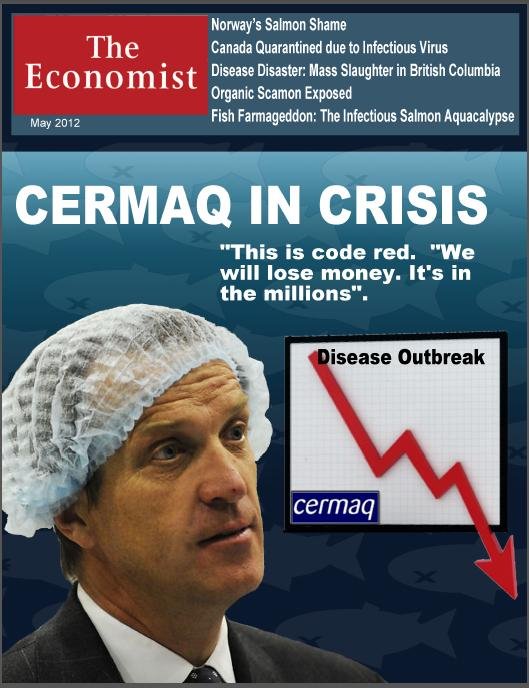
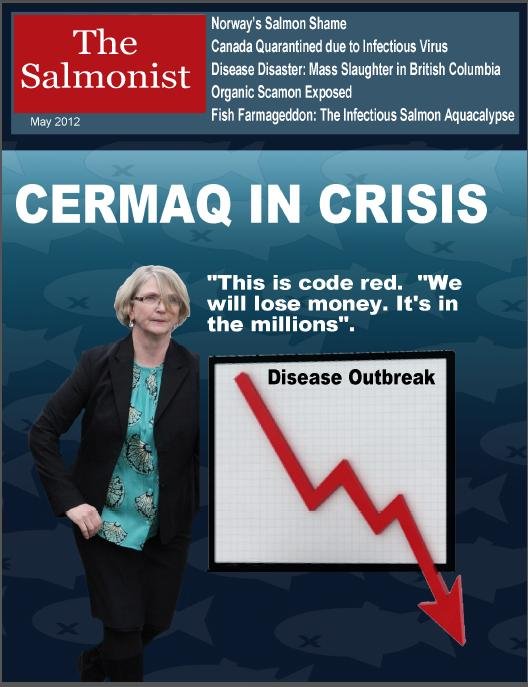
The Disaster News Network (18 May) and CBC News (17 May) reported Laurie Jensen, Cermaq’s PR flak in British Columbia, as saying:
“This is code red. This is not good news for the fish or for the companies. We will contain this however way we can. We will lose money, it's in the millions. There's a lot of money at stake.”

Read more via "Cermaq in Crisis in Canada!"; "Candid Canada: Infectious Diseases Going Viral!" and "Cermaq's "Code Red" in
Clayoquot Sound"
Watch a CHEK News (18 May) report on the 'Fish Farm Quarantine' – online
here

The broadcast
features Cermaq's Laurie Jensen who claimed that IHN was not a
problem:

Last year, Laurie
Jensen also claimed during a public meeting in Tofino that ISA was an "East
coast disease" (before ISA was reported
at a salmon farm in Clayoquot Sound on the West coast of Canada). Jensen
compared maintaining fish health in feed lot sized fish farms was "like growing
carrots" or removing "sick kids in a daycare."

Watch video online here
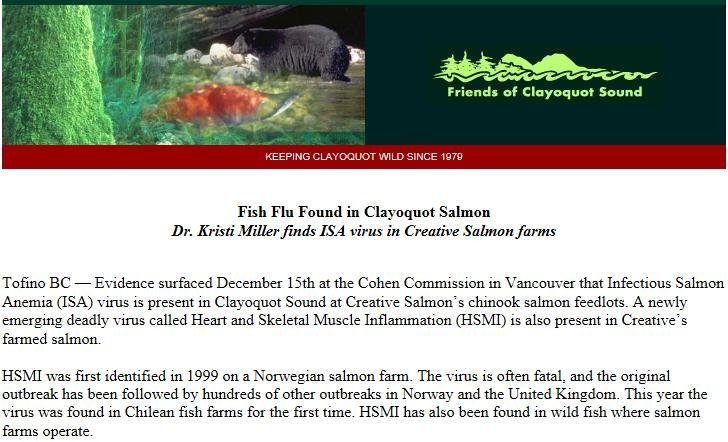
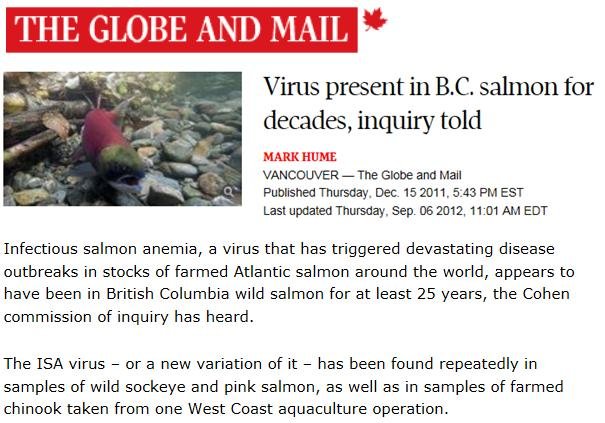
During the Cohen Commission in December 2011, it was reported that ISA was present in British Columbia:
In British Columbia, farmed Atlantic salmon bought in supermarkets in Vancouver also tested positive for ISA. "There is strong evidence this virus is European strain," wrote Alexandra Morton in March 2012.

Read more via "Atlantic salmon in Lower Mainland markets test positive for ISA virus: Morton"
In April 2012, Alexandra Morton reported 44 out of 45 farm salmon purchased from the Superstore and T&T markets throughout Vancouver tested positive for a newly identified Norwegian virus. The piscine reovirus weakens the fish’s heart causing Heart and Skeletal Muscle Inflammation (HSMI).

“The news that these viruses are here in the Clayoquot Sound UNESCO Biosphere Reserve is chilling” said Bonny Glambeck of Friends of Clayoquot Sound. “This virus puts at risk not only the wild salmon, but the ancient rainforest for which this region is renowned.”