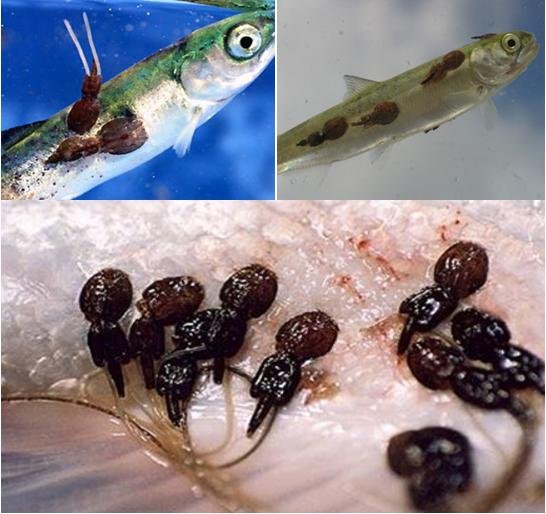
Ireland is not the only country where sea lice levels are out of control: data obtained from the Scottish Government via a Freedom of Information request reveals that salmon and sea trout across Scotland are infested with sea lice parasites.
Infestation levels of up to 145 sea lice per fish were recorded in
Shieldaig in Wester Ross in 2012; up to 196 in Laxford in West
Sutherland in 2008; 117 in Tarbert in Argyll in 2008; 113 in Sunart in
Lochaber in 2008; and a staggering 1001 sea lice on a salmon sampled in
Kanaird in Wester Ross in 2008.
Out of over 11,000 wild salmon and sea trout sampled since 1997 there
were 2,750 fish with 10 or more sea lice; 913 fish with 50 or more sea
lice and 367 fish with 100 or more sea lice. By far the worst area was
Dundonnell in Wester Ross which reported 40 out of the top 50
infestation rates.
Read Scotland's sea lice data in full via FishyLeaks and read a press release online here

The
latest information published
by the Scottish Salmon Producers’ Organisation (SSPO) also reveals alarming sea
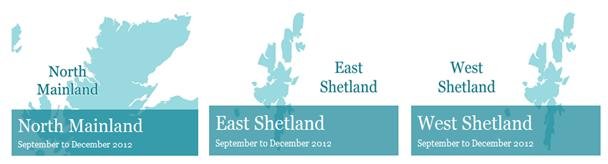
lice infestation levels across Scotland – with salmon farms in North
Mainland 263% above the suggested lice treatment threshold of 1.0 adult
female lice per fish; East
Shetland 135% above the threshold; and West
Shetland 123% above the threshold for the period September to December
2012.
Salmon
farming companies operating in Scotland all report growing parasite
problems. “Grieg Seafood Hjaltland has
suffered from sea lice challenges in 2012,” stated Grieg Seafood in their Q3
2012 report published
last month. “All regions reported higher sea lice levels at the end of the second
quarter of 2012 compared to the second quarter of 2011,” stated Marine Harvest’s
Q2 2012 report. Marine Harvest publishes
their Q4 2012 report on Wednesday (6 February).
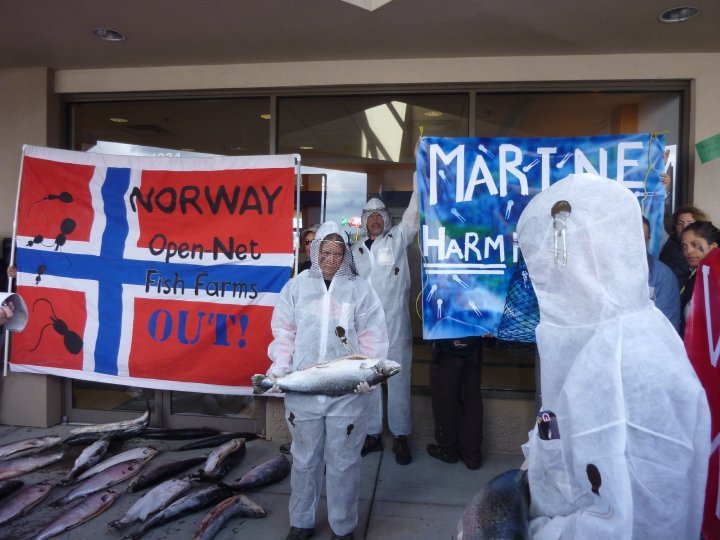
Read more via "Dear Marine Harmfest" and "Marine Harvest's Salmonopoly Loss – Q3 $$$$$s drop 86%!"
The
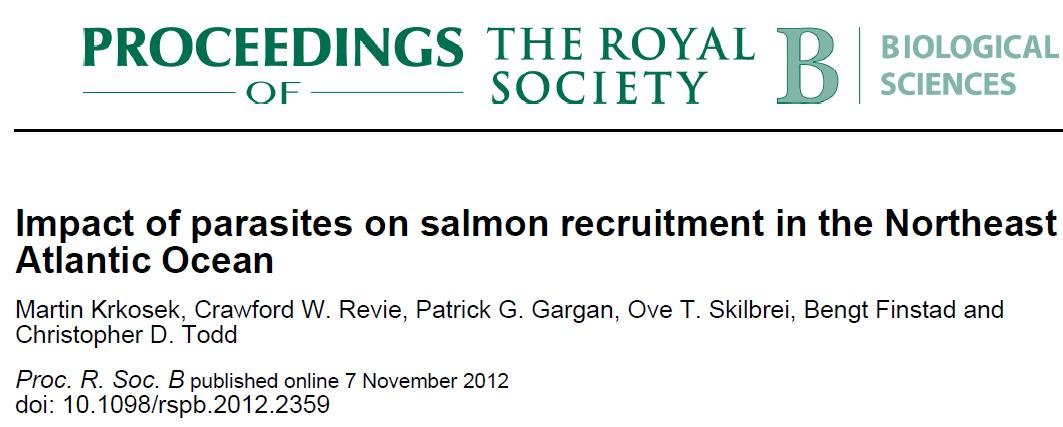
revelations comes in the wake of a scientific paper published in November 2012
by the Royal
Society which detailed the lethal
impact of sea lice from salmon farms on wild salmon.
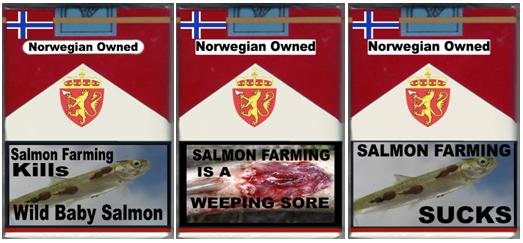
Scottish Government research published
in February 2013 also revealed that sea lice from salmon farms impact wild sea
trout up to 32km away. Another report published
in January 2013 by the Rivers & Fisheries Trusts of Scotland detailed
increased sea lice infestation levels on wild sea trout during 2012 compared to
2011 with an “increasing infestation pattern” and “detrimental
lice loads above critical thresholds”.
The
Scottish Government is protecting the salmon farming from public scrutiny. Last month, Marine Scotland refused
a FOI request on sea lice as “manifestly unreasonable”. In a debate
in the Scottish Parliament (9 January), the Minister for Environment and
Climate Change, Paul Wheelhouse, also refused to publish sea lice data. “It is
not that farm-by-farm data on sea lice are not being collected; the issue is
more to do with publication,” testified
the Minister. “Why does the Scottish
Government seem so reluctant to go down the route of farm-by-farm data
collection on sea lice?” asked
Alex Fergusson MSP.

The issue of sea lice was also debated
in December 2012 by the Scottish Parliament’s Rural Affairs, Climate Change and
Environment Committee. “Publication
of aggregated figures, controlled by the SSPO, on a delayed basis, is
unacceptable in the 21st century for an industry which claims to ‘have nothing
to hide’,” stated
one submission. “We need data on a ‘real
time’ basis to allow mitigation measures to be put in place at the time of
crisis, rather than reflecting on a disaster after it has occurred. Why can
Scotland not have a similar level of transparency from the largely
Norwegian-owned operators to that which they are obliged to comply with in
their home country?”

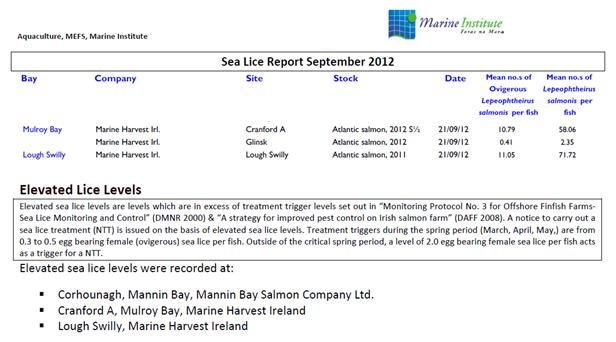
FishyLeaks revealed in December 2012 that sea lice data compiled by the Irish Government's Marine Institute for November 2012 revealed that Marine Harvest breached sea lice protocol levels (set at 2 ovigerous – pregnant
female – lice per farmed salmon) for the FIFTH month running.
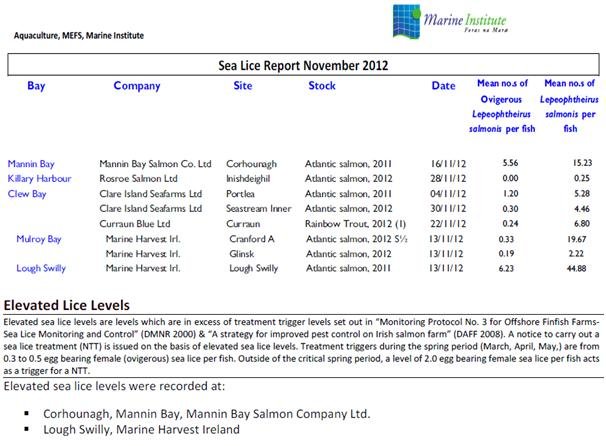
Read more about sea lice-infested Irish salmon farms online via: "FishyLeaks: Lice-Infested Irish Salmon (Continued)!"
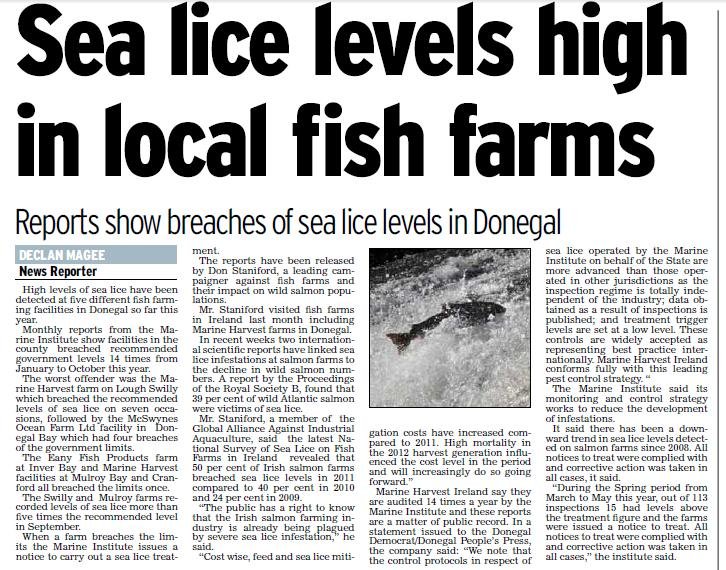
The Donegal Democrat reported (17 December):
Read a year’s data on sea lice infestation on Irish salmon farms via:
– November 2012: online here
– October 2012: online here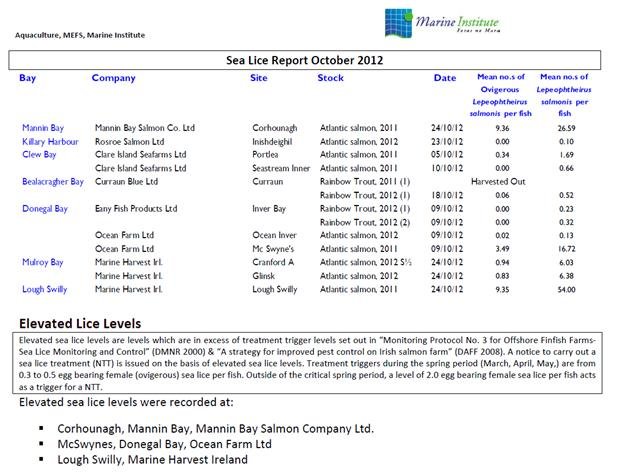
And for September 2012:
– August 2012: online here
– July 2012: online here
– June 2012: online here
– May 2012: online here
– April 2012: online here
– March 2012: online here
– February 2012: online here
– December 2011 to January 2012: online here
Read more sea lice information online via FishyLeaks
For
recent news on sea lice infestation on salmon farms please read:
“44
sea lice per salmon at Marine Harvest Ireland farm” (Undercurrent News, 18
December 2012)
“FishyLeaks:
Lice-Infested Irish Salmon (Continued)!” (FishyLeaks, 18 December)
“Sea
lice levels in local fish farms: reports show breaches of sea lice levels in
Donegal” (Donegal Democrat, 17 December 2012)
“Sea
lice hitting Donegal farms hardest – problems in Lough Swilly and Mulroy Bay”
(Donegal news, 30 November 2012)
“Wild
salmon stocks ‘wiped out’ by sea lice” (Irish Independent, 16 November
2012)
“Devastating
impact on Wild Salmon populations from Sea Lice” (Inland Fisheries Ireland,
15 November 2012)
“Parasites
have big impact on salmon” (Royal Society, 7 November 2012)
“Sea
lice killing large numbers of salmon” (BBC News, 7 November 2012)
“Farmed
fish lice link to wild salmon deaths” (The Herald, 7 November 2012)
“Chemicals
to control salmon parasites” (The Guardian, 10 September)
“Keeping
Salmon Farming Problems Secret” (Sunday Herald, 1 July 2012)
“Sea lice infestations
on farmed Atlantic salmon in Scotland and the use of ectoparasitic treatments”
(Veterinary Record, 2012)
“Inspections
reveal 'sea lice breaches' in salmon farms” (BBC News, 7 April 2011)
“Government
'gagged' by salmon farming industry” (Sunday Herald, 26 December 2010)
“Plague
of 'super-lice' threatens wild salmon” (Caledonian Mercury, 16 February
2010)