Here's a press release from the Global Alliance Against Industrial Aquaculture (download as a PDF online here):
Despite escalating sea lice, infectious disease and chemical resistance problems, the Scottish Environment Protection Agency (SEPA) is gearing up to remove biomass limits on salmon farming production across Scotland.
Read more in The Sunday Herald: "Plans to scrap fish farm limits slammed" (8 January)
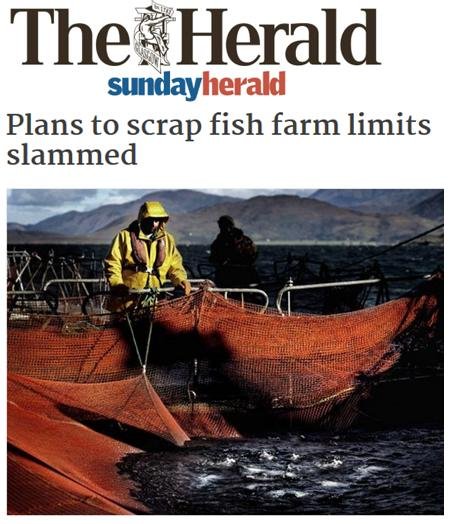
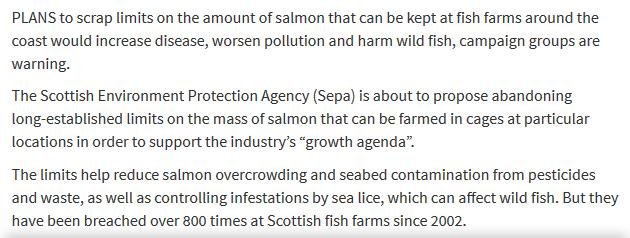
In a submission to the Scottish Parliament in November 2016, SEPA admitted that the 'Depositional Zone Regulation' "puts responsibility for day-to-day management of sites into the hands of responsible fish farmers and ensures that at the correct locations, the regulatory framework more closely matches the growth agenda pursued by the industry by removing imposition of a limit on biomass, and enabling operators to increase biomass where environmental monitoring demonstrates that the location is able to cope" [1].
"Lifting the limits is sheer lunacy," said Don Staniford of the Global Alliance Against Industrial Aquaculture. "The salmon farming industry is already dealing with escalating sea lice infestation, chemical resistance and disease problems. Removing what few controls there are in favour of unrestricted expansion is a recipe for ruin. Salmon farms, even at current capacity, are causing widespread benthic impacts with dead zones under cages. Increasing production will effectively wipe out whole swathes of the sea-bed. This is Scotland's very own 'Silent Spring of the Sea'."
In October 2016, the industry unveiled plans to double aquaculture production by 2030 (read more via "Aquaculture Growth to 2030"). Whilst Scotland is set to lift biomass limits, Norway has a strict cap on production with a maximum allowable biomass per licence of 780 tons (except in Troms and Finnmark where it is 900 tons) [2].
"Like a watchdog without bark or bite, SEPA is bending over backwards to accommodate the relentless expansion of salmon farming," continued Staniford. "SEPA is cravenly kowtowing to the Scottish Government's reckless plan to double aquaculture by 2030. The answer to the industry's growing problems is blowing in the wind – decrease not increase production. Yet SEPA is deaf, blind and dumb to environmental concerns."
In Scotland, there are many sites with a maximum biomass limit of 2,500 tonnes with an industry average of 1,159 tonnes. Even with such high biomass limits there have been significant breaches of biomass limits:
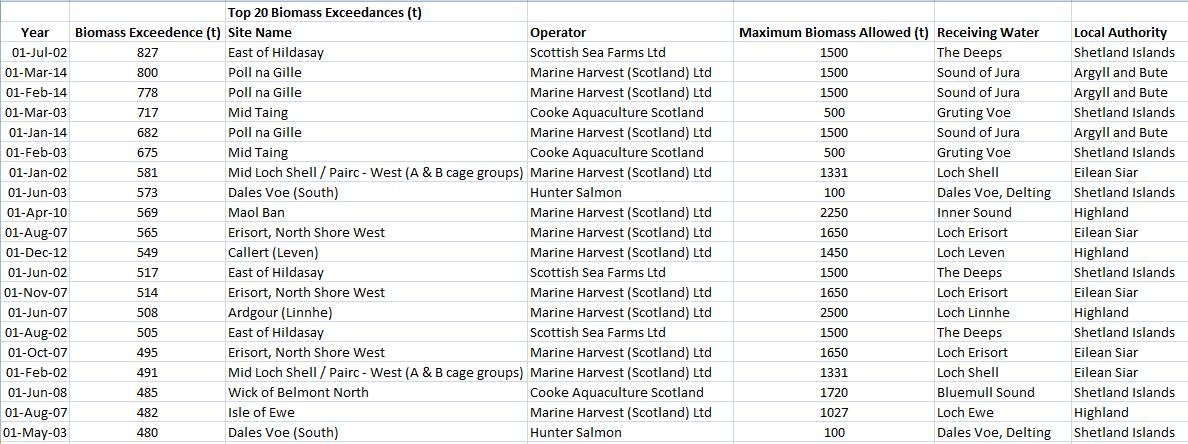
In fact, since 2002 there have been over 858 biomass exceedances totalling 74,284 tonnes with Marine Harvest alone accounting for 24,539 tonnes of exceedances:
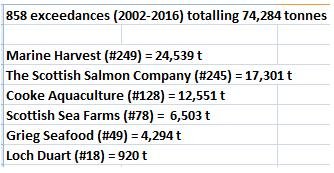
Download an Excel spreadsheet of data obtained from SEPA online here
The news comes in the wake of revelations that the use of toxic chemicals on salmon farms in Scotland increased ten-fold over the last decade:
- Press & Journal: "Scottish salmon farming ‘fighting a losing battle’ against sea lice"
- The Times: "Toxic war on salmon lice soars 1,000%"
- Press Release: Scottish Salmon's Lethal Legacy
- The Sunday Times: "Salmon industry toxins soar by 1000 per cent"
Notes to Editors:
[1] A submission by SEPA to the Scottish Parliament in November 2016 – available online here – included:
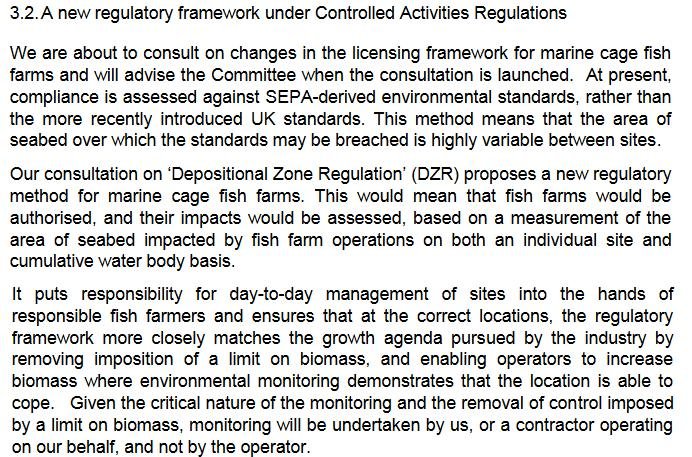
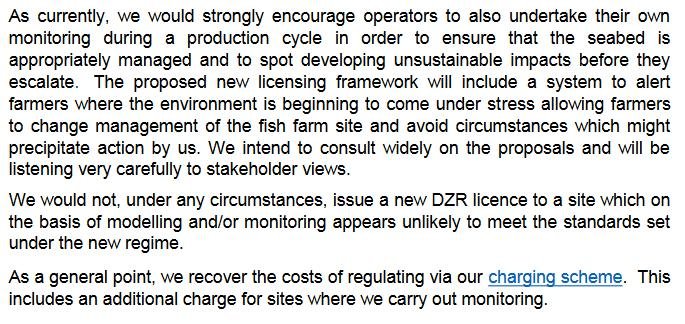
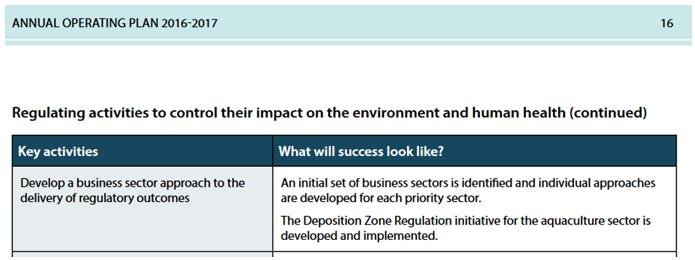
The Deposition Zone Regulation initiative for aquaculture was also cited in SEPA's Annual Operating Plan 2016-2017 issued on 1 April 2016:
[2] From the Norwegian Government's web-page "Licence Requirements in Aquaculture":
"The maximum allowable biomass per licence is 780 tons, except in the counties of Troms and Finnmark where the maximum allowable biomass per licence is 900 tons. There are also biomass limitations on the individual production sites. The biomass limitation varies from site to site and is determined by the carrying capacity of the site."
Download FOI data from SEPA on fish farm compliance (2011-2015) - online here