Scientific References:
The new aspects of using some safe feed additives on alleviated imidacloprid toxicity in farmed fish: a review. Reviews in Aquaculture, April 2020
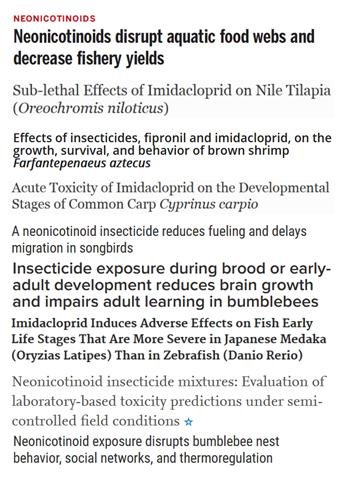
Insecticide exposure during brood or early-adult development reduces brain growth and impairs adult learning in bumblebees. Proceedings of the Royal Society B, March 2020
Coral Reef Organisms: Differential Sensitivities to an Agricultural Pesticide. Ocean Sciences, February 2020
Environmental pollution from pet parasiticides. Veterinary Record, January 2020
Sub-lethal Effects of Imidacloprid on Nile Tilapia (Oreochromis niloticus). Water, Soil & Air Pollution, January 2020
The effect of air exposure, handling stress and imidacloprid on the susceptibility of Crassostrea gigas to ostreid herpesvirus 1 (OsHV-1). Aquaculture Environment Interactions, December 2019
Neonicotinoids disrupt aquatic food webs and decrease fishery yields. Science, November 2019
Effects of insecticides, fipronil and imidacloprid, on the growth, survival, and behavior of brown shrimp Farfantepenaeus aztecus. PLoS One, October 2019
Acute Toxicity of Imidacloprid on the Developmental Stages of Common Carp Cyprinus carpio. Toxicology & Environmental Health Sciences, October 2019
A neonicotinoid insecticide reduces fueling and delays migration in songbirds. Science, September 2019
Imidacloprid Induces Adverse Effects on Fish Early Life Stages That Are More Severe in Japanese Medaka (Oryzias Latipes) Than in Zebrafish (Danio Rerio). Chemosphere, June 2019
Trends in Neonicotinoid Pesticide Residues in Food and Water in the United States, 1999-2015. Environmental Health, January 2019
Neonicotinoid insecticide mixtures: Evaluation of laboratory-based toxicity predictions under semi-controlled field conditions. Environmental Pollution, December 2018
Neonicotinoid exposure disrupts bumblebee nest behavior, social networks, and thermoregulation. Science, November 2018
Were the sharp declines of dragonfly populations in the 1990s in Japan caused by fipronil and imidacloprid? An analysis of Hill’s causality for the case of Sympetrum frequens. Environmental Science & Pollution Research, October 2018
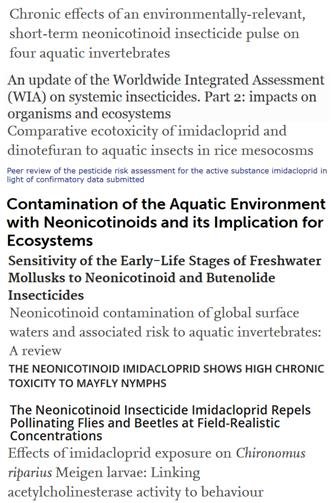
Chronic effects of an environmentally-relevant, short-term neonicotinoid insecticide pulse on four aquatic invertebrates. Science of the Total Environment, October 2018
Imidacloprid Poisoning: An Emerging Cause of Potentially Fatal Poisoning. Indian Journal of Critical Care Medicine, November 2017
An update of the Worldwide Integrated Assessment (WIA) on systemic insecticides. Part 2: impacts on organisms and ecosystems. Environmental Science & Pollution Research, November 2017
Neonicotinoids act like endocrine disrupting chemicals in newly-emerged bees and winter bees. Scientific Reports, September 2017
Comparative ecotoxicity of imidacloprid and dinotefuran to aquatic insects in rice mesocosms. Ecotoxicology & Environmental Safety, April 2017
Peer review of the pesticide risk assessment for the active substance imidacloprid in light of confirmatory data submitted. European Food Safety Authority, November 2016
Contamination of the Aquatic Environment with Neonicotinoids and its Implication for Ecosystems. Frontiers in Environmental Science, November 2016
Sensitivity of the Early-Life Stages of Freshwater Mollusks to Neonicotinoid and Butenolide Insecticides. Environmental Pollution, November 2016
A Screening of Multiple Classes of Pharmaceutical Compounds for Effect on Preadult Salmon Lice Lepeophtheirus Salmonis. Journal of Fish Diseases, October 2016
Neonicotinoid contamination of global surface waters and associated risk to aquatic invertebrates: A review. Environment International, January 2015
Effects of neonicotinoids and fipronil on non-target invertebrates. Environmental Science & Pollution Research, September 2014
Environmental fate and exposure; neonicotinoids and fipronil. Environmental Science & Pollution Research, August 2014
Systemic pesticide concerns extend beyond the bees. Current Biology, August 2014
Risks of large-scale use of systemic insecticides to ecosystem functioning and services. Environmental Science & Pollution Research, July 2014
A review of the direct and indirect effects of neonicotinoids and fipronil on vertebrate wildlife. Environmental Science & Pollution Research, June 2014
An overview of the environmental risks posed by neonicotinoid insecticides. Journal of Applied Ecology, June 2013
Macro-Invertebrate Decline in Surface Water Polluted with Imidacloprid. PLoS One, May 2013
The neonicotinoid imidacloprid shows high chronic toxicity to mayfly nymphs. Environmental Toxicology & Chemistry, February 2013
The Neonicotinoid Insecticide Imidacloprid Repels Pollinating Flies and Beetles at Field-Realistic Concentrations. PLoS One, January 2013
Exposure to multiple cholinergic pesticides impairs olfactory learning and memory in honeybees. Journal of Experimental Biology, 2013
Cumulative ecological impacts of two successive annual treatments of imidacloprid and fipronil on aquatic communities of paddy mesocosms. Ecotoxicology & Environmental Safety, June 2012
Effects of imidacloprid exposure on Chironomus riparius Meigen larvae: Linking acetylcholinesterase activity to behaviour. Ecotoxicology & Environmental Safety, July 2011
Behaviour and Growth of Chironomus riparius Meigen (Diptera: Chironomidae) under Imidacloprid Pulse and Constant Exposure Scenarios. Water, Air, & Soil Pollution, December 2010
Hazard identification of imidacloprid to aquatic environment. Chemosphere, August 2009
Acute Human Self-Poisoning With Imidacloprid Compound: A Neonicotinoid Insecticide. PloS One, April 2009
Fatal Intoxication With Imidacloprid Insecticide. American Journal of Emergency Medicine, June 2008
Acute and Chronic Toxicity of Imidacloprid to the Aquatic Invertebrates Chironomus tentans and Hyalella azteca under Constant- and Pulse-Exposure Conditions. Archives of Environmental Contamination & Toxicology, January 2008
Comparative toxicity of imidacloprid, of its commercial liquid formulation and of diazinon to a non-target arthropod, the microcrustacean Daphnia magna. Chemosphere, July 2007
Acute toxicity of imidacloprid and fipronil to a nontarget aquatic insect, Simulium vittatum Zetterstedt cytospecies IS-7. Bulletin of Environmental Contamination & Toxicology, May 2005
Read in full online here

Media Articles:
"Mowi asks to trial new lice drug in Scotland"
"What’s Bad for Bees Could Be Bad for Marine Life, Too"
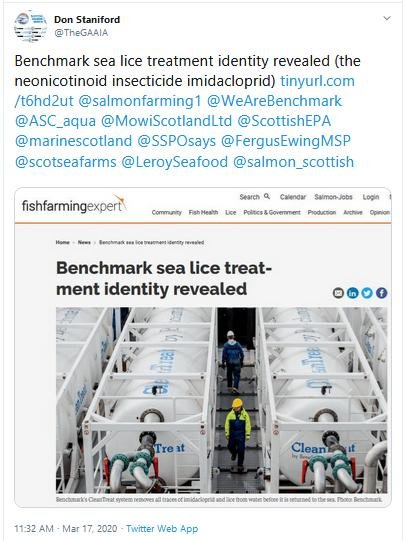
"Benchmark sea lice treatment identity revealed"
"Calls for greater transparency over ‘toxic’ new fish farm product"
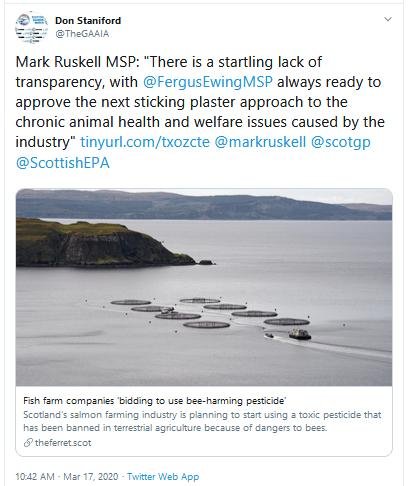
"Fish farm companies ‘bidding to use bee-harming pesticide’"
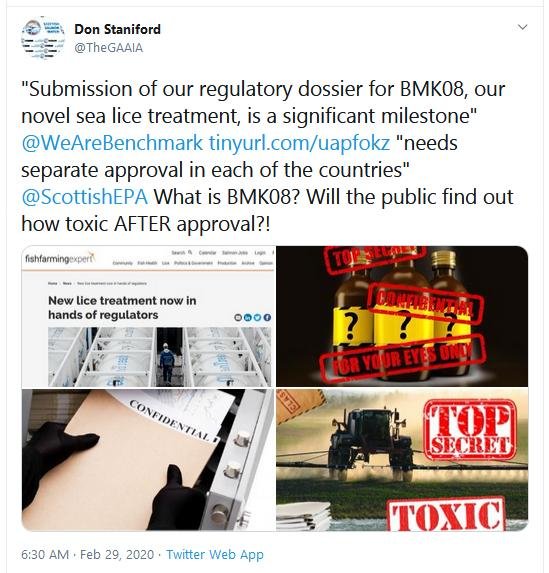
"New lice treatment now in hands of regulators"
"Aquaculture biotech group Benchmark raises $50 million to launch new sealice treatment"
"Benchmark seeks millions more for novel sea lice treatments"
"Official fears revealed over toxic threat of salmon trade"
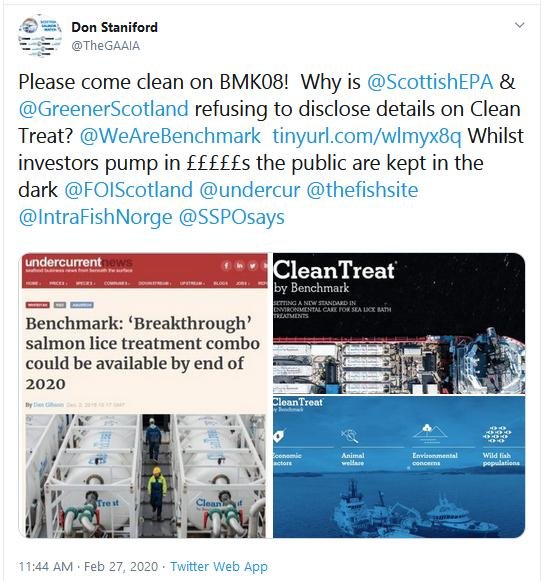
"Benchmark: ‘Breakthrough’ salmon lice treatment combo could be available by end of 2020"
"Oysters growers lose battle to use neonicotinoid"
"Pesticide banned in oyster farming"
"As pesticide ban looms, oyster growers fear the worst"
"Neonicotinoid pesticides killing songbirds by turning them 'anorexic"
"Fergus Ewing should stop Michael Russell on pesticides, says leaked email"
"Alarm over toxic pesticide sprayed on Scotland’s woodlands"
"Groundbreaking new sea lice treatment: “All the trials have shown 100 per cent efficacy”
"Two-year wait for ‘next generation’ lice treatment"
"New lice bath ‘100% effective’ and pollution-free"
"Patent sought for neonicotinoid-based sea louse treatment"
"Chemotherapeutants against salmon lice Lepeophtheirus salmonis –screening of efficacy"
"Dette er det nye lusemiddelet Salmo Pharma skal teste ut"
"Neonicotinoids: Scottish government calls for ban to be delayed"
Press Releases & Blogs:
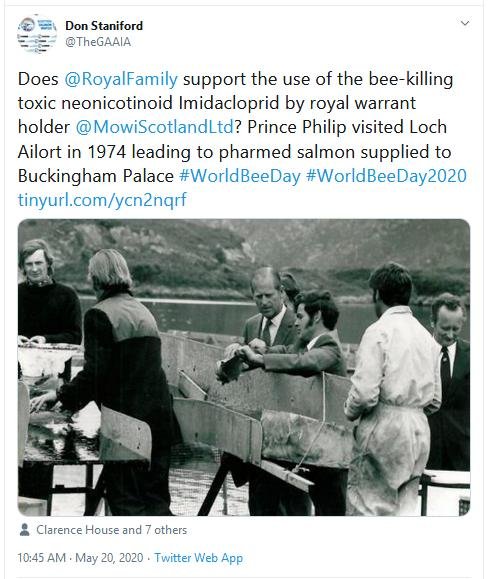
Letter to the Prince of Wales re. bee-killing Imidacloprid use at royal warrant holder Mowi
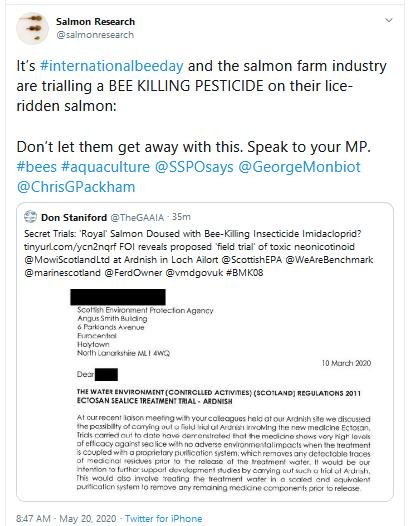
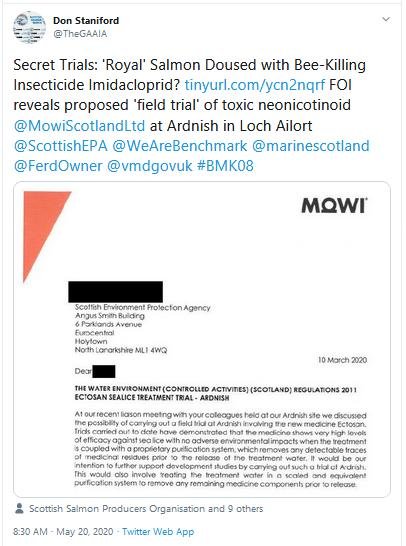
Secret Trials: 'Royal' Salmon Doused with Bee-Killing Insecticide Imidacloprid?
Follow the Salmoney – the Norwegian tobacco billionaire behind the Neonicotinoid Imidacloprid
Letter to SEPA: Please Come Clean on Imidacloprid!
Letter to Scottish Ministers, SEPA & the VMD re. Imidacloprid
FOI requests on Imidacloprid to SEPA, VMD & the Scottish Government
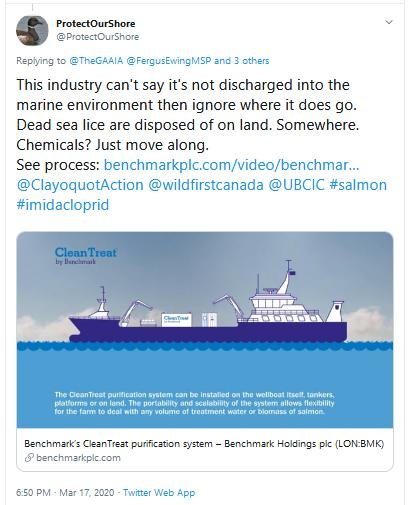
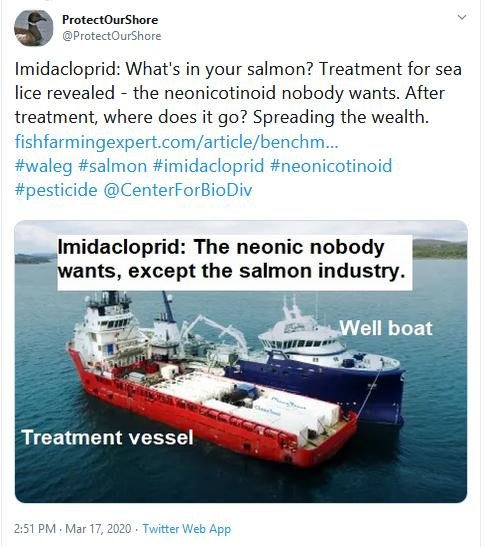
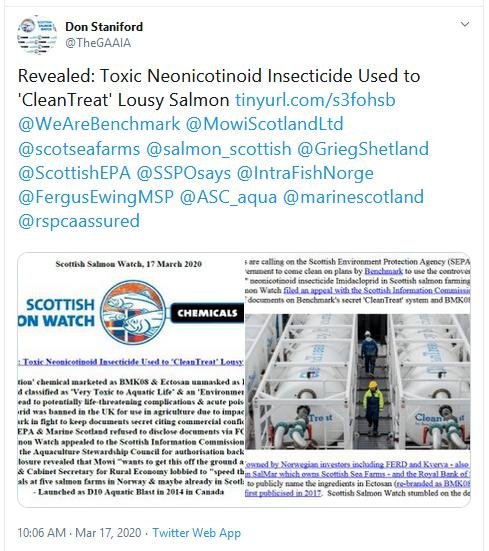
Revealed: Toxic Neonicotinoid Insecticide Used to 'CleanTreat' Lousy Salmon
Cleaning Tox-Sick Scottish Salmon
CleanTreat: FOI Disclosures by the Scottish Government to Scottish Salmon Watch
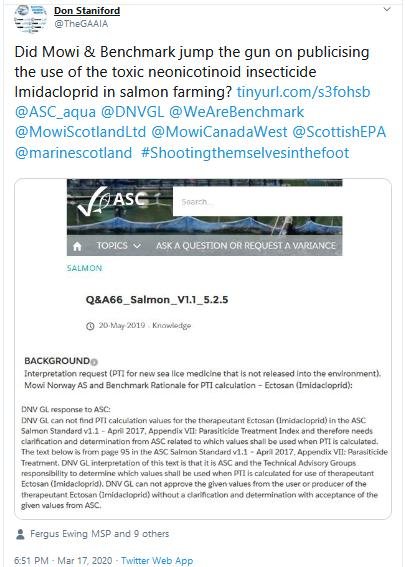
ASC interpretation request for Imidacloprid by Mowi Norway
Legal Action Defends Washington's Decision to Keep Neurotoxins Out of Willapa Bay, Grays Harbor
Heavy Neonicotinoid Insecticide Contamination Damaging British Rivers
NRDC to EPA: Red Flags on Imidacloprid Health Risks
Further evidence shows bees at risk from neonicotinoid pesticides
European Legislation Banning Imidacloprid in 2018:
Further restrictions on neonicotinoids agreed
Environment Secretary backs further restrictions on neonicotinoid pesticides
UK will back total ban on bee-harming pesticides, Michael Gove reveals
UK Expert Committee on Pesticides advice: Risks arising from the use of neonicotinoid pesticides
Neonicotinoid and fipronil insecticides harm birds and fish and reduce their food supply
Patents:
Patent sought for neonicotinoid-based sea louse treatment
Videos:
Letter to the Prince of Wales re. bee-killing Imidacloprid use at royal warrant holder Mowi
Secret Trials: 'Royal' Salmon Doused with Bee-Killing Insecticide Imidacloprid?
Follow the Salmoney – the Norwegian tobacco billionaire behind the Neonicotinoid Imidacloprid
ENDS Report: "Calls for greater transparency over ‘toxic’ new fish farm product"
Letter to SEPA: Please Come Clean on Imidacloprid!
Letter to Scottish Ministers, SEPA & the VMD re. Imidacloprid
FOI requests on Imidacloprid to SEPA, VMD & the Scottish Government
The Ferret: "Fish farm companies ‘bidding to use bee-harming pesticide’"
Revealed: Toxic Neonicotinoid Insecticide Used to 'CleanTreat' Lousy Salmon
Media coverage of Benchmark's 'CleanTreat', Ectosan and BMK08
Media Backgrounder: Chemically Embalmed Scottish Salmon
Sunday Times: "Official fears revealed over toxic threat of salmon trade"
Cleaning Tox-Sick Scottish Salmon
CleanTreat: FOI Disclosures by the Scottish Government to Scottish Salmon Watch
All is Not Well With Sick Scottish Salmon