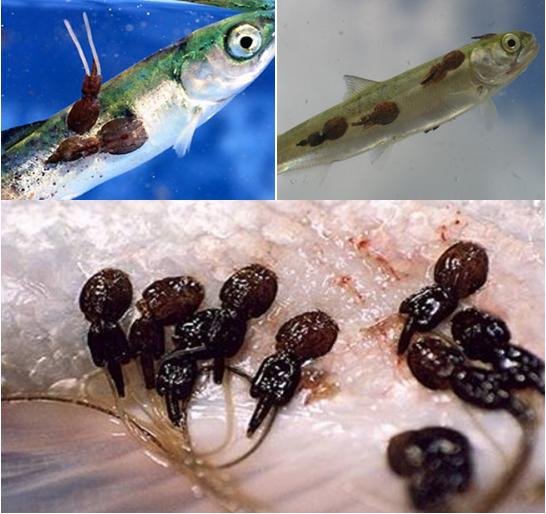
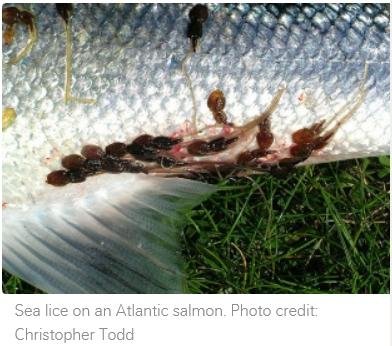
Another leaked Government report reveals that Irish farmed salmon – including so-called 'organic' salmon farms – are breaching sea lice levels by over three times. Marine Harvest's salmon farm in Lough Swilly is so infested with parasitic sea lice that there are over 44 sea lice per farmed salmon whilst Mannin Bay's 'organic' salmon are infested with over 15 sea lice per farmed salmon!
The latest data (November 2012) compiled by the Marine Institute reveals that Marine Harvest is breaching the sea lice protocol level (set at 2 ovigerous – pregnant female – lice per farmed salmon) for the FIFTH month running.
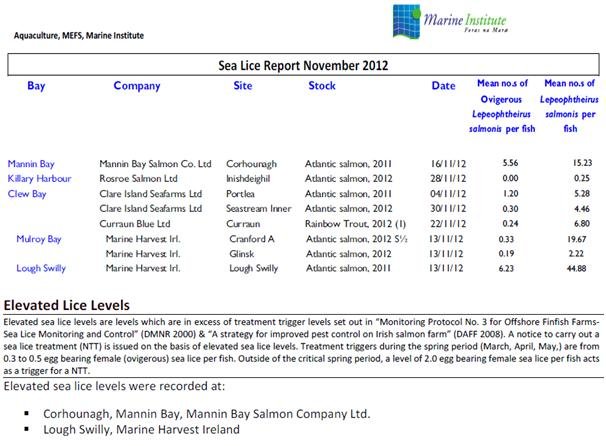
Read November 2012 sea lice data in full online here
In October
2012 Marine Harvest’s
feedlot in Lough Swilly was infested with 54 sea lice per fish – breaching the Irish Government’s protocol levels by almost five
times along with Mannin Bay’s ‘organic’ salmon feedlot at Corhounagh. In September
2012, Marine Harvest’s feedlot in Mulroy Bay was infested with 58 sea lice per
farmed salmon with Lough Swilly infested with a staggering 71 sea lice per
farmed salmon (both over five times the Government’s sea lice protocol level)!
"Lice-infested Irish farmed salmon – including 'organic' salmon – should be avoided like the plague," said Don Staniford of the Global Alliance Against Industrial Aquaculture (GAAIA) in a press release (18 December). "The Irish Government should be controlling sea lice infestation on salmon farms not promoting even bigger feedlots such as the proposed 15,000 tonne farm in Galway Bay. Join the boycott of farmed salmon and send a festive message to Marine Harvest that disease-ridden salmon does not belong on the Christmas menu."
GAAIA is now writing to the Irish Government, Marine Harvest and Mannin Bay Salmon asking why sea lice protocol levels are being flagrantly breached month after month – read GAAIA's letter (18 December) addressed to the Ireland's Fisheries Minister Simon Coveney online here

The Sunday Times Ireland reported (16 December):
"Gerry O’Donohue,
of Mannin Bay Salmon, said sea lice were a problem for all fish farms. “We are
very careful to ensure that we do everything possible to reduce the prevalence
of sea lice in our salmon stocks. “We have learnt
how to deal with sea lice. When high levels of sea lice are detected, we
harvest the fish, as we are an organic farm and do not use chemicals,” he said.
Marine Harvest
Ireland said its Irish operations were audited 14 times a year by officials
from the Marine Institute. “We note that
the control protocols in respect of sea lice operated by the Marine Institute
on behalf of the state are more advanced than those operated in other
jurisdictions, as the inspection regime is independent of the industry,” the
company said.
“Data obtained
as a result of inspections is published and treatment trigger levels are set at
a low level. These controls are widely accepted as representing best practice
internationally. Marine Harvest Ireland conforms fully with this leading pest
control strategy. “We implement
tried-and- tested operational procedures to control sea lice. On occasion,
given certain climatic conditions, lice can be more prevalent and this has
occurred this year as the reports clearly illustrate.”
The Marine
Institute declined to comment."
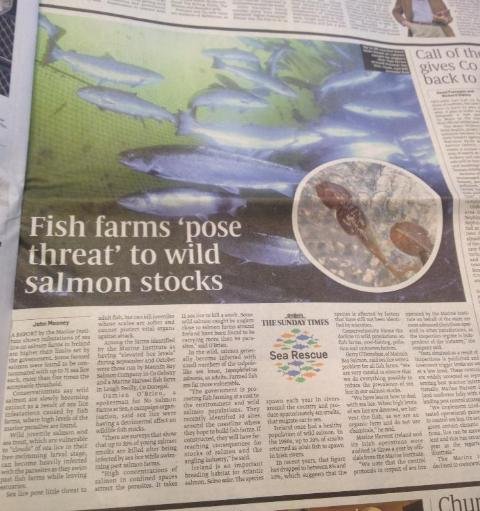
The Irish Examiner reported (15 December):
"Marine Harvest last night defended the figures, saying sea
lice control protocols in Ireland are “more advanced that those operated in
other jurisdictions as the inspection regime is totally independent of the
industry”. “These controls are widely accepted as representing best
practice internationally. Marine Harvest Ireland conforms fully with this
leading pest-control strategy. Given certain climatic conditions, lice can be
more prevalent and this has occurred this year”.
“Best practice in fish farming is to optimise stock rotation
and separation by having a greater number of sites. This is why we have applied
for a licence application for Shot Head, to complement our existing facilities
by enabling improved rotation of our fish stocks therefore implementing best
practice with regard to lice control.”
The Donegal Democrat reported (17 December):
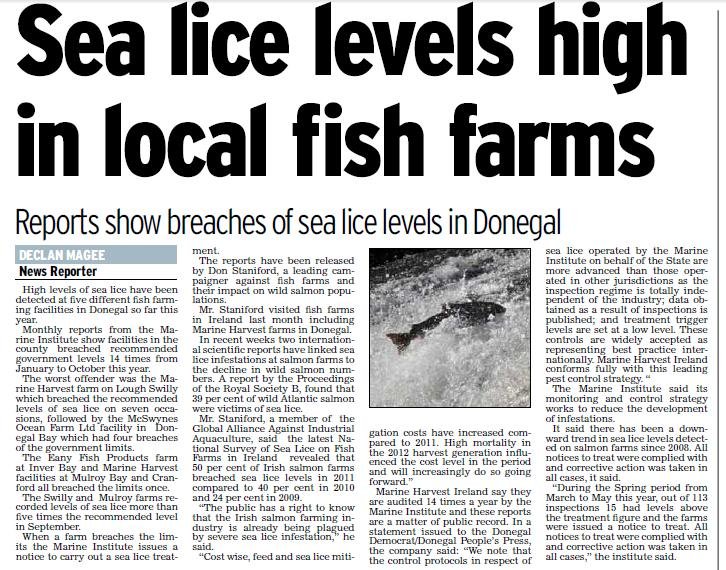
Read a year’s data on sea lice infestation on Irish salmon farms via:
– November 2012: online here
– October 2012: online here
– September 2012: online here
– August 2012: online here
– July 2012: online here
– June 2012: online here
– May 2012: online here
– April 2012: online here
– March 2012: online here
– February 2012: online here
– December 2011 to January 2012: online here
For more details see below and visit FishyLeaks
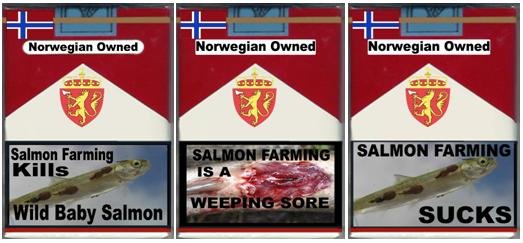
FishyLeaks, 11 December 2012
FishyLeaks
today published leaked
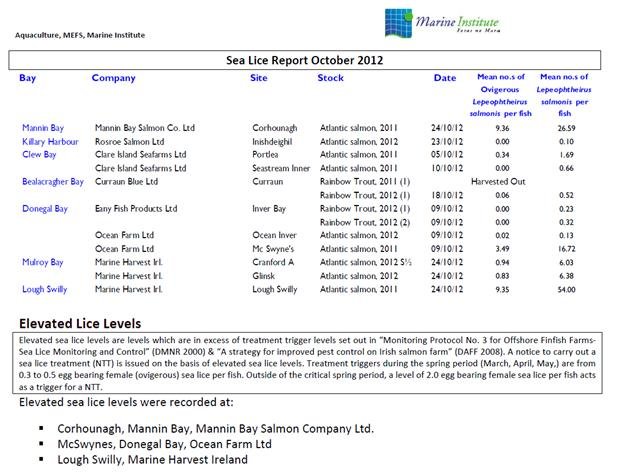
Government reports cataloguing sea lice infestation on Irish salmon farms. The damming data reveals that Marine Harvest’s
feedlot in Lough Swilly was infested with 54 sea lice per fish in October
2012 – breaching the Irish Government’s protocol levels by almost five
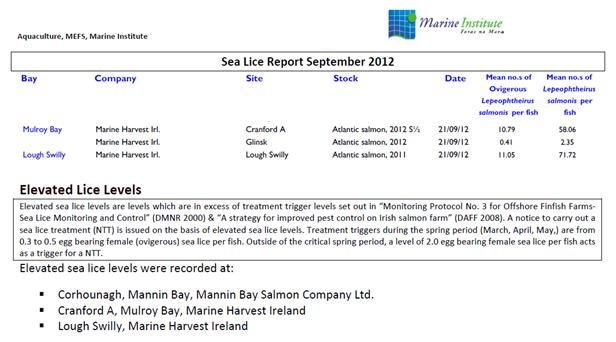
times along with Mannin Bay’s ‘organic’ salmon feedlot at Corhounagh. In September
2012, Marine Harvest’s feedlot in Mulroy Bay was infested with 58 sea lice per
farmed salmon with Lough Swilly infested with a staggering 71 sea lice per
farmed salmon (both over five times the Government’s sea lice protocol level)!
Read the leaked sea lice data online via FishyLeaks – including for October
2012:
And for September
2012:
“The
public has a right to know that the Irish salmon farming industry is already being
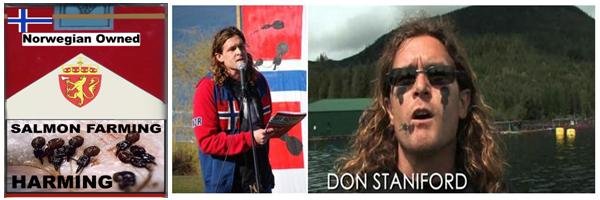
plagued by severe sea lice infestation,” said Don Staniford of the Global
Alliance Against Industrial Aquaculture (GAAIA). “It is a policy of reckless abandon for the
Irish Government to be sponsoring a new 15,000 tonne feedlot in Galway Bay –
the world’s largest salmon farm which would double salmon farming production in
Ireland. Sea lice infested Irish farmed
salmon – including so-called ‘organic’ salmon – should be avoided like the
plague.”
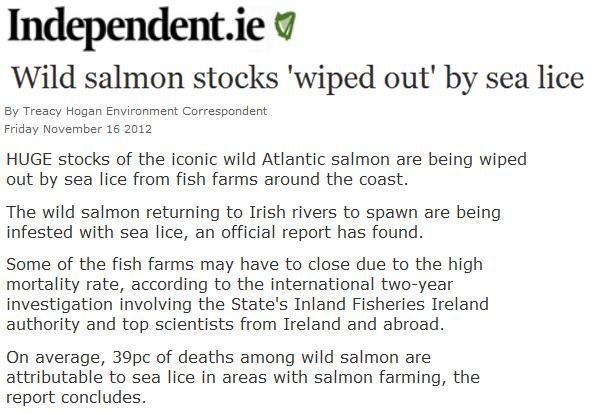
The
revelations come in the wake of a scientific paper published by the Royal Society
in November which concluded that sea lice from salmon farms are killing wild
salmon. Minister of State with
responsibility for Natural Resources Fergus O Dowd, TD, welcomed
the report stating “from the results of this detailed study, it is crucial that
sea lice levels are maintained below these protocol levels”. However, the latest ‘National Survey of Sea
Lice on Fish Farms in Ireland – 2011’ published
in February 2012 revealed that 50% of Irish salmon farms breached sea lice
levels in 2011 compared to 40% in 2010 and 24% in 2009.
“The
sea lice crisis is spiralling out of control,” continued Staniford. “No wonder the Marine Institute is
desperately trying to keep a lid on the can of worms that is Irish salmon
farming. Ireland is a law unto itself
and is consistently flouting sea lice protocol levels despite a 2009 complaint
to the European Commission by Salmon
Watch Ireland. Shame on Ireland and shame
on Norway which now controls over 60% of Irish salmon farming production via
the Norwegian-owned multinational Marine Harvest.”
The
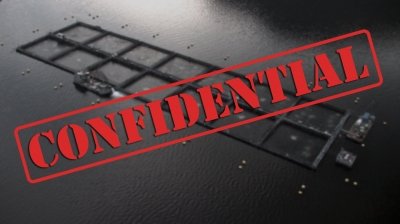
leaked monthly sea lice reports
include the following statement: “This data is supplied for the information of
the recipient only and is not to be used, cited, or conveyed to third parties
without the prior permission of the Marine Institute”. However
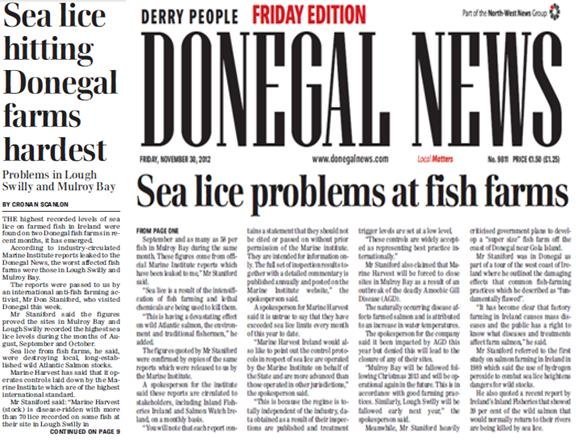
last month, the Donegal News (30 November) reported
on sea lice problems in Mulroy Bay and Lough Swilly. “They are intended for information only,” said
a spokesperson for the Irish Government.
“The full set of inspection results together with a detailed commentary is
published annually and posted on the Marine Institute web-site.”
Marine
Harvest’s latest financial
reports refer to disease problems including sea lice infestation and Amoebic
Gill Disease. Marine
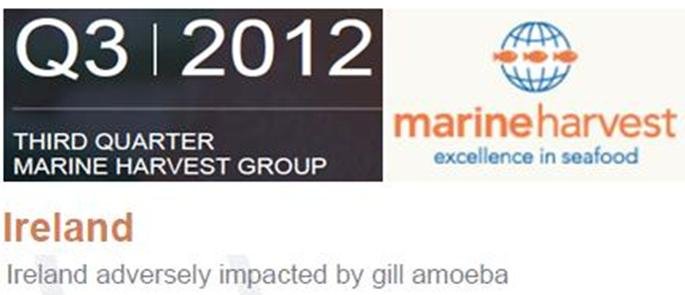
Harvest’s Q3 2012 report
includes:
“As indicated in previous reports,
the Irish operation has struggled with amoebic gill disease (AGD) for several
months. Due to favourable conditions for the amoeba in the quarter, mortality
losses and treatment costs were substantial in the period. Exceptional mortality
in the amount of NOK 14 million was recognised in the quarter.”
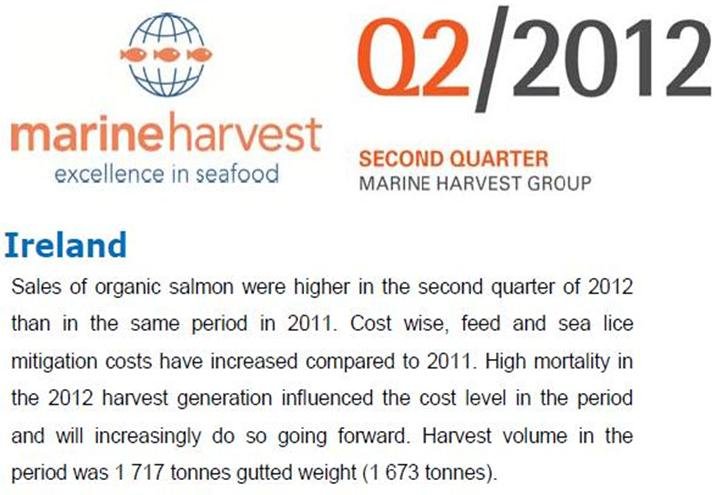
Marine Harvest’s Q2 2012 report includes:
“Cost wise, feed and sea lice mitigation
costs have increased compared to 2011. High mortality in the 2012 harvest
generation influenced the cost level in the period and will increasingly do so
going forward.”
Watch a video report
from Marine Harvest’s operations in Mulroy Bay – online via “"Nature has struck back
and said "No More!" – Noel Carr on Salmon Farms”
Read
a year’s sea lice data in full online via FishyLeaks
– October 2012: online here
– September 2012: online here
– August 2012: online here
– July 2012: online here
– June 2012: online here
– May 2012: online here
– April 2012: online here
– March 2012: online here
– February 2012: online here
– December 2011 to January 2012: online here
For more background on sea lice infestation at Marine Harvest's operations in Lough Swilly and Mulroy Bay please read the Donegal News (30 November) - online here
Read the press release (11 December) – "Lice-Infested Irish Salmon: Ireland’s Parasite Problems Exposed by ‘FishyLeaks’" – in full online here