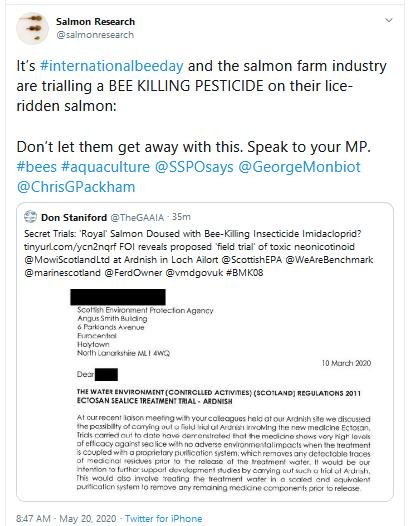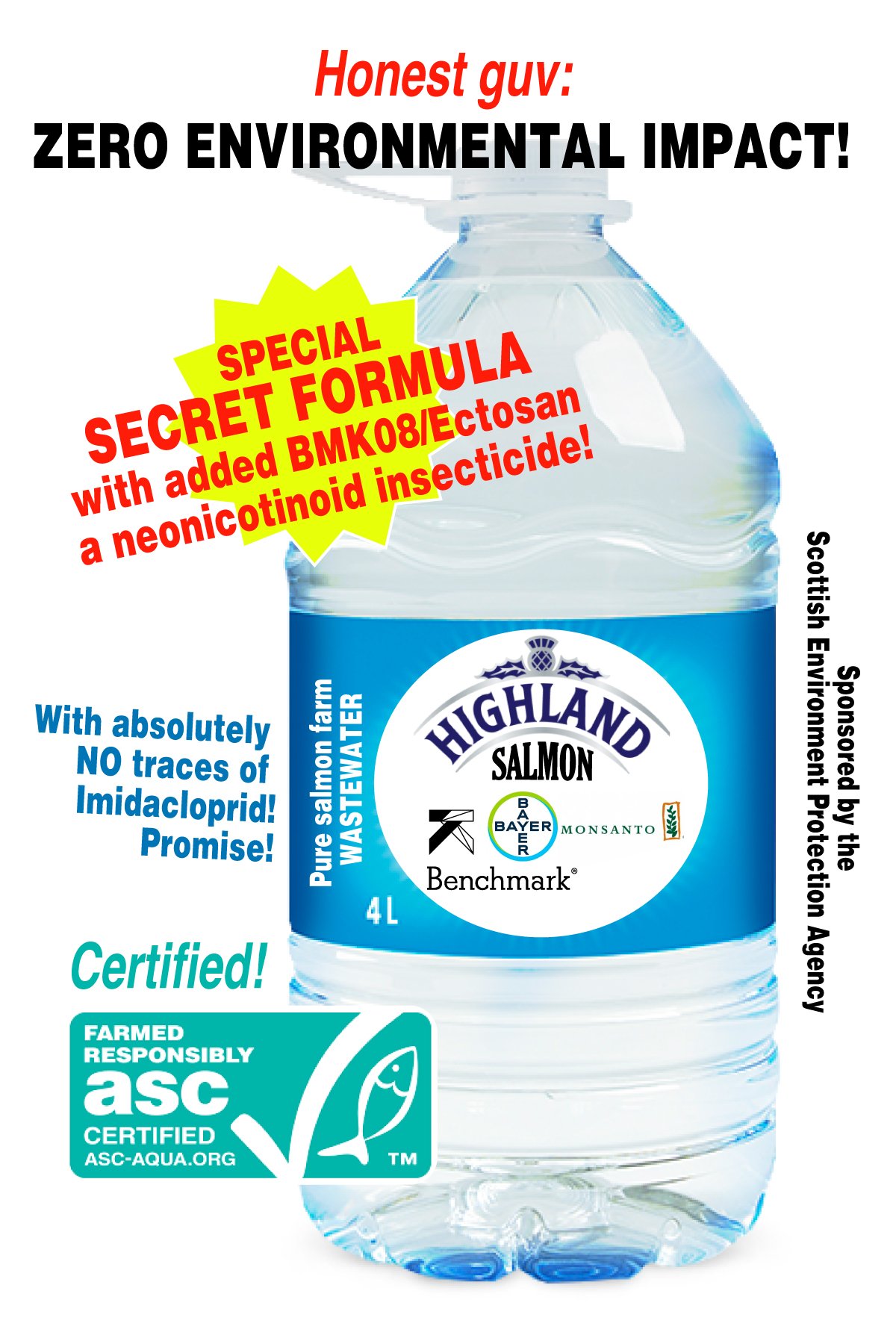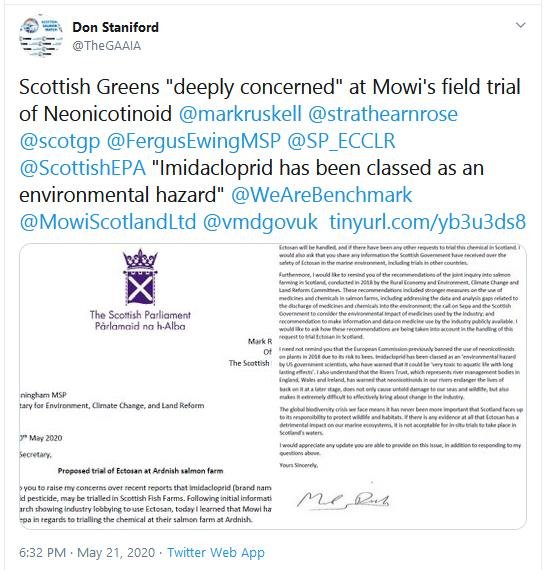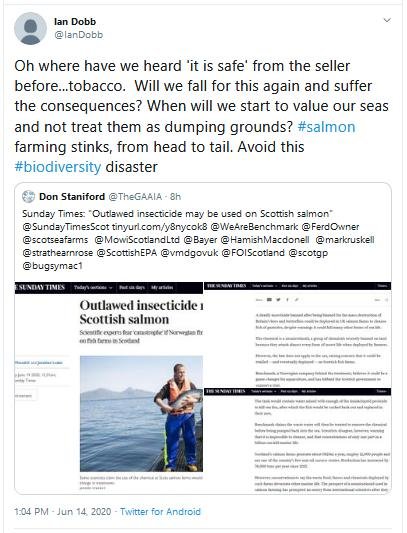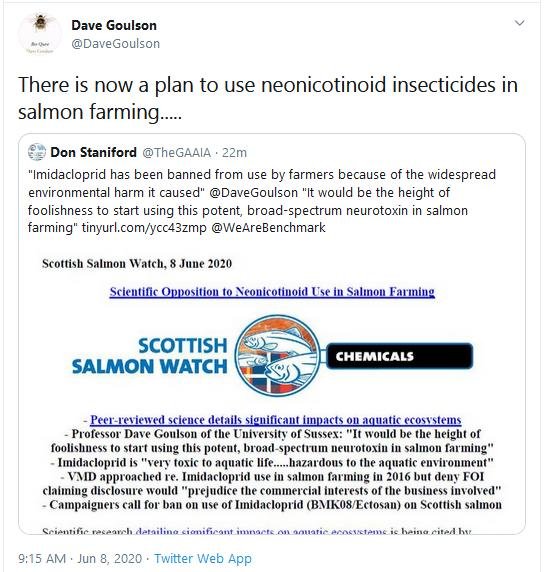
Since Scottish Salmon Watch broke the shocking news in March that Benchmark's secret BMK08 lice treatment is actually the toxic neonicotinoid insecticide Imidacloprid (banned for use in terrestrial agriculture in 2018), scientific opposition has been building.

The Sunday Times reported today (14 June 2020):

Earlier this week, Scottish Salmon Watch solicited scientific support for a ban on the use of Imidacloprid in salmon farming and shared a scientific dossier – "Imidacloprid – A Neonicotinoid Insecticide Toxic to Aquatic Life" – detailing environmental impacts of Imidacloprid on aquatic ecosystems.
Here's some feedback from the scientific community:
From: Francisco Sanchez-Bayo <francisco.sanchez-bayo@sydney.edu.au>
Date: Tue, Jun 9, 2020 at 9:54 AM
Subject: Re: Imidacloprid – scientific research into aquatic impacts?
To: Don Staniford <salmonfarmingkills@gmail.com>
Dear Don,
Excellent compilation!
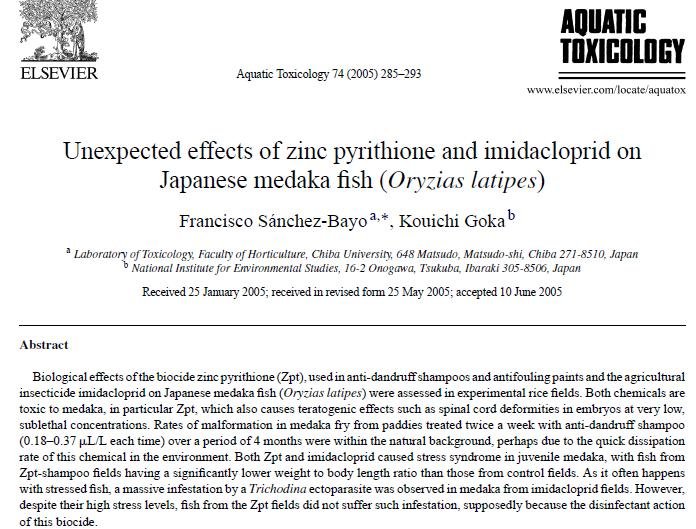
You can add our recent paper on the time-cumulative effects of neonicotinoids on aquatic and terrestrial arthropods:
See link at https://doi.org/10.3390/ijerph17051629
From: Francisco Sanchez-Bayo <francisco.sanchez-bayo@sydney.edu.au>
Date: Wed, Jun 10, 2020 at 8:34 AM
Subject: Re: Imidacloprid – scientific research into aquatic impacts?
To: Don Staniford <salmonfarmingkills@gmail.com>
Dear Don,
Imidacloprid is extremely toxic to invertebrates by acute and chronic exposure, and therefore makes no sense at all to use it in the aquatic environment, where organisms are exposed continuously to residues, no matter how low they may be.
The claim that imidacloprid would not enter the aquatic environment upon release of the salmon is fallacious. Due to the mobility of this chemical in water, it is practically impossible to avoid contamination of the receiving waters. Even tiny residues below 1 ppb can deplete populations of aquatic insects! For this reason, I cannot understand the need for using a product that contains imidacloprid for salmon farming. There are other chemicals used for disinfecting fish that cause less harm to the aquatic environment than imidacloprid, so why should anyone insist in using the worst chemical in the market for such a purpose?
Best regards
Francisco Sánchez-Bayo, PhD
Honorary Associate
School of Life and Environmental Sciences | The University of Sydney
currently: Department of Environment and Energy | Canberra
https://www.researchgate.net/profile/Francisco_Sanchez-Bayo2
Date: Mon, Jun 29, 2020 at 9:31 AM
Subject: Re: Imidacloprid patent – new information on use in salmon farming
To: Don Staniford <salmonfarmingkills@gmail.com>
Honorary Associate
School of Life and Environmental Sciences | The University of Sydney
currently: Department of Agriculture, Water and Environment | Canberra
From: Ryan Prosser <prosserr@uoguelph.ca>
Date: Tue, Jun 9, 2020 at 1:27 AM
Subject: Re: Imidacloprid – scientific research into aquatic impacts?
To: Don Staniford <salmonfarmingkills@gmail.com>
Don,
Thank you for reaching out. My research group has conducted research on the toxicity of imidacloprid on freshwater invertebrates. It is relatively toxic to freshwater invertebrates, particularly freshwater insects (e.g., larval midges, larval mayflies). It’s toxicity to vertebrates (e.g., fish) is relatively low. The Pest Management Regulatory Agency (PMRA; agency responsible for registering pesticides for use in Canada) has reduced the uses of imidacloprid due to high risks to pollinators.
I would be concerned about the release of imidacloprid into aquatic systems. It may not cause direct toxicity to fish but it will likely have an adverse effect on invertebrate populations, which will likely result in indirect effects on non-invertebrate populations and be detrimental to the ecosystem. I haven’t read deeply into BMK08/Ectosan/D10 Aqua Blast but the couple articles I read from your dossier indicated that the fish are passed through a bath that contains imidacloprid. The big question would be how much of the imidacloprid is being released back into the aquatic ecosystem in which the fish are being reared? Risk is a function of toxicity and exposure, so we know that imidacloprid can be relatively toxic to invertebrates, so the important question is the frequency and level of exposure.
Again, thank you for reaching out. This would make for a very interesting ecological risk assessment.
Kind regards,
Ryan Prosser
Assistant Professor – Environmental Toxicology
School of Environmental Sciences
University of Guelph
https://ses.uoguelph.ca/people/ryan-prosser
From: Whitehorn, Penelope(IMK) <penelope.whitehorn@kit.edu>
Date: Mon, Jun 8, 2020 at 6:40 PM
Subject: RE: Imidacloprid use in salmon farming in Scotland – concerns?
To: Don Staniford <salmonfarmingkills@gmail.com>
Hi Don,
Yes sure:
"It is extremely worrying that imidacloprid is being considered for use in salmon farming. This neurotoxin is known to cause harm to a wide range of non-target species and I’m yet to see any convincing evidence that it is safe or appropriate to use in an aquatic environment."
Hope that helps!
Best wishes,
Penelope
https://www.imk-ifu.kit.edu/staff_Penelope_Whitehorn.php
From: Jean-Marc Bonmatin <bonmatin@cnrs-orleans.fr>
Date: Mon, Jun 8, 2020 at 6:00 PM
Subject: Re: Imidacloprid – scientific research into aquatic impacts?
To: Don Staniford <salmonfarmingkills@gmail.com>, MBVL <mbvl@club-internet.fr>
Dear Don,
Thank you for your e-mail and the quality of your dossier below (your link).
I think that the use of imidacloprid as it is presented for salmon farming, will be catastrophic for aquatic invertebrates and even for fishes.
I am not sure that EU regulations still apply to Scotland because of Brexit (EU banned imidacloprid, except for greenhouses).
I send your demand to our specialists within our IUCN Task Force on Systemic Pesticides (www.tfsp.info), and I will let you know in case they identify some new information on this topic that could be useful for you
Best regards,
JMB
Dr BONMATIN Jean-Marc, Research scientist
Centre National de la Recherche Scientifique (CNRS)
Centre de Biophysique Moléculaire, 45071 Orléans, France
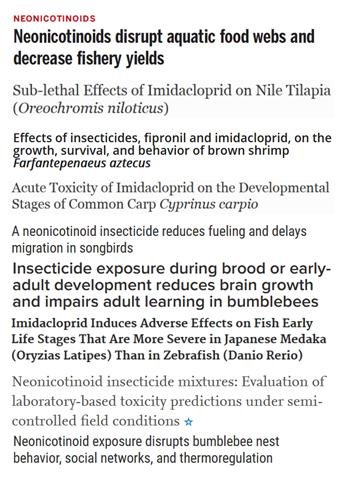
Here's some scientific papers referenced via "Imidacloprid – A Neonicotinoid Insecticide Toxic to Aquatic Life":
Scientific References:
The new aspects of using some safe feed additives on alleviated imidacloprid toxicity in farmed fish: a review. Reviews in Aquaculture, April 2020
Insecticide exposure during brood or early-adult development reduces brain growth and impairs adult learning in bumblebees. Proceedings of the Royal Society B, March 2020
Coral Reef Organisms: Differential Sensitivities to an Agricultural Pesticide. Ocean Sciences, February 2020
Environmental pollution from pet parasiticides. Veterinary Record, January 2020
Sub-lethal Effects of Imidacloprid on Nile Tilapia (Oreochromis niloticus). Water, Soil & Air Pollution, January 2020
The effect of air exposure, handling stress and imidacloprid on the susceptibility of Crassostrea gigas to ostreid herpesvirus 1 (OsHV-1). Aquaculture Environment Interactions, December 2019
Neonicotinoids disrupt aquatic food webs and decrease fishery yields. Science, November 2019
Effects of insecticides, fipronil and imidacloprid, on the growth, survival, and behavior of brown shrimp Farfantepenaeus aztecus. PLoS One, October 2019
Acute Toxicity of Imidacloprid on the Developmental Stages of Common Carp Cyprinus carpio. Toxicology & Environmental Health Sciences, October 2019
A neonicotinoid insecticide reduces fueling and delays migration in songbirds. Science, September 2019
Imidacloprid Induces Adverse Effects on Fish Early Life Stages That Are More Severe in Japanese Medaka (Oryzias Latipes) Than in Zebrafish (Danio Rerio). Chemosphere, June 2019
Trends in Neonicotinoid Pesticide Residues in Food and Water in the United States, 1999-2015. Environmental Health, January 2019
Neonicotinoid insecticide mixtures: Evaluation of laboratory-based toxicity predictions under semi-controlled field conditions. Environmental Pollution, December 2018
Neonicotinoid exposure disrupts bumblebee nest behavior, social networks, and thermoregulation. Science, November 2018
Were the sharp declines of dragonfly populations in the 1990s in Japan caused by fipronil and imidacloprid? An analysis of Hill’s causality for the case of Sympetrum frequens. Environmental Science & Pollution Research, October 2018
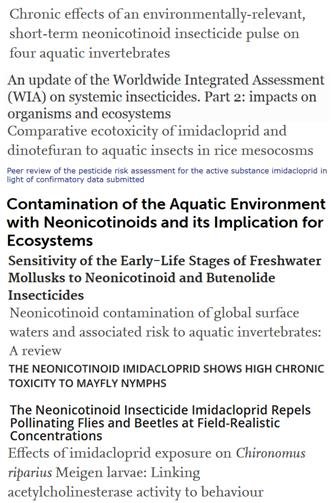
Chronic effects of an environmentally-relevant, short-term neonicotinoid insecticide pulse on four aquatic invertebrates. Science of the Total Environment, October 2018
Imidacloprid Poisoning: An Emerging Cause of Potentially Fatal Poisoning. Indian Journal of Critical Care Medicine, November 2017
An update of the Worldwide Integrated Assessment (WIA) on systemic insecticides. Part 2: impacts on organisms and ecosystems. Environmental Science & Pollution Research, November 2017
Neonicotinoids act like endocrine disrupting chemicals in newly-emerged bees and winter bees. Scientific Reports, September 2017
Comparative ecotoxicity of imidacloprid and dinotefuran to aquatic insects in rice mesocosms. Ecotoxicology & Environmental Safety, April 2017
Peer review of the pesticide risk assessment for the active substance imidacloprid in light of confirmatory data submitted. European Food Safety Authority, November 2016
Contamination of the Aquatic Environment with Neonicotinoids and its Implication for Ecosystems. Frontiers in Environmental Science, November 2016
Sensitivity of the Early-Life Stages of Freshwater Mollusks to Neonicotinoid and Butenolide Insecticides. Environmental Pollution, November 2016
A Screening of Multiple Classes of Pharmaceutical Compounds for Effect on Preadult Salmon Lice Lepeophtheirus Salmonis. Journal of Fish Diseases, October 2016
Neonicotinoid contamination of global surface waters and associated risk to aquatic invertebrates: A review. Environment International, January 2015
Effects of neonicotinoids and fipronil on non-target invertebrates. Environmental Science & Pollution Research, September 2014
Environmental fate and exposure; neonicotinoids and fipronil. Environmental Science & Pollution Research, August 2014
Systemic pesticide concerns extend beyond the bees. Current Biology, August 2014
Risks of large-scale use of systemic insecticides to ecosystem functioning and services. Environmental Science & Pollution Research, July 2014
A review of the direct and indirect effects of neonicotinoids and fipronil on vertebrate wildlife. Environmental Science & Pollution Research, June 2014
An overview of the environmental risks posed by neonicotinoid insecticides. Journal of Applied Ecology, June 2013
Macro-Invertebrate Decline in Surface Water Polluted with Imidacloprid. PLoS One, May 2013
The neonicotinoid imidacloprid shows high chronic toxicity to mayfly nymphs. Environmental Toxicology & Chemistry, February 2013
The Neonicotinoid Insecticide Imidacloprid Repels Pollinating Flies and Beetles at Field-Realistic Concentrations. PLoS One, January 2013
Exposure to multiple cholinergic pesticides impairs olfactory learning and memory in honeybees. Journal of Experimental Biology, 2013
Cumulative ecological impacts of two successive annual treatments of imidacloprid and fipronil on aquatic communities of paddy mesocosms. Ecotoxicology & Environmental Safety, June 2012
Effects of imidacloprid exposure on Chironomus riparius Meigen larvae: Linking acetylcholinesterase activity to behaviour. Ecotoxicology & Environmental Safety, July 2011
Behaviour and Growth of Chironomus riparius Meigen (Diptera: Chironomidae) under Imidacloprid Pulse and Constant Exposure Scenarios. Water, Air, & Soil Pollution, December 2010
Hazard identification of imidacloprid to aquatic environment. Chemosphere, August 2009
Acute Human Self-Poisoning With Imidacloprid Compound: A Neonicotinoid Insecticide. PloS One, April 2009
Fatal Intoxication With Imidacloprid Insecticide. American Journal of Emergency Medicine, June 2008
Acute and Chronic Toxicity of Imidacloprid to the Aquatic Invertebrates Chironomus tentans and Hyalella azteca under Constant- and Pulse-Exposure Conditions. Archives of Environmental Contamination & Toxicology, January 2008
Comparative toxicity of imidacloprid, of its commercial liquid formulation and of diazinon to a non-target arthropod, the microcrustacean Daphnia magna. Chemosphere, July 2007
Acute toxicity of imidacloprid and fipronil to a nontarget aquatic insect, Simulium vittatum Zetterstedt cytospecies IS-7. Bulletin of Environmental Contamination & Toxicology, May 2005
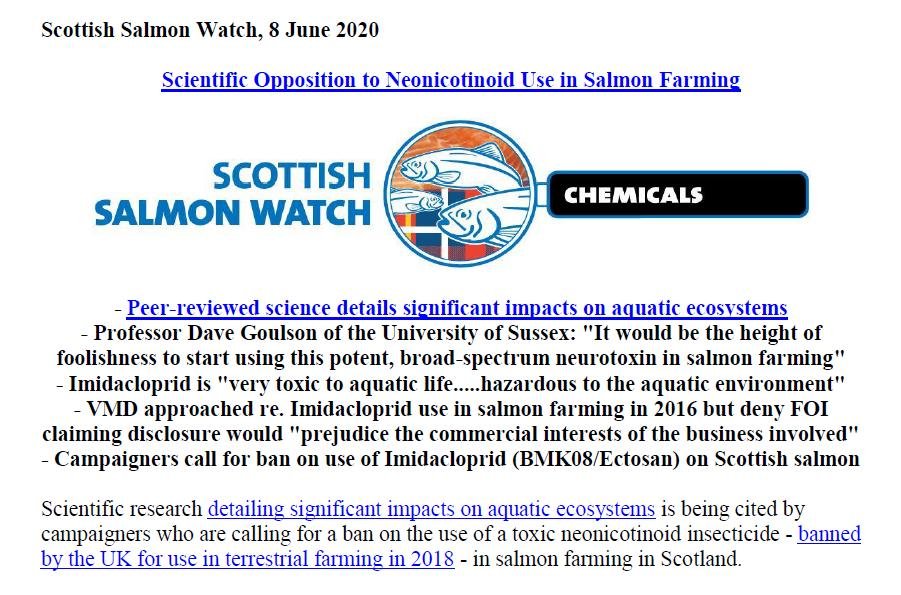
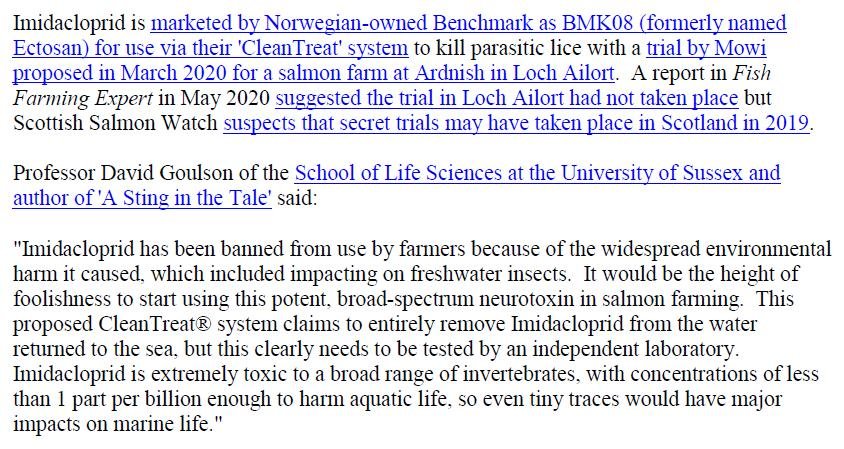
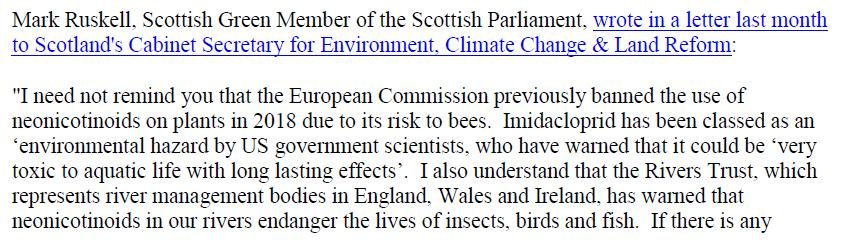
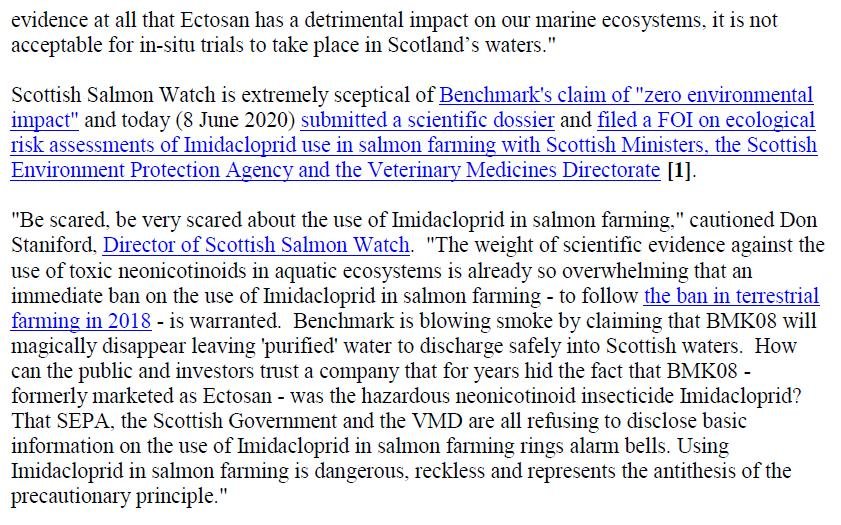
Scottish Salmon Watch reported (8 June 2020):
Read more via:
- Sunday Times: "Outlawed insecticide may be used on Scottish salmon"
- Scientific Opposition to Neonicotinoid Use in Salmon Farming
- Backgrounder: "Imidacloprid – A Neonicotinoid Insecticide Toxic to Aquatic Life"
- FOI letter on Scientific Concerns re. Imidacloprid Use in Scottish Salmon Farming